





Key takeaways
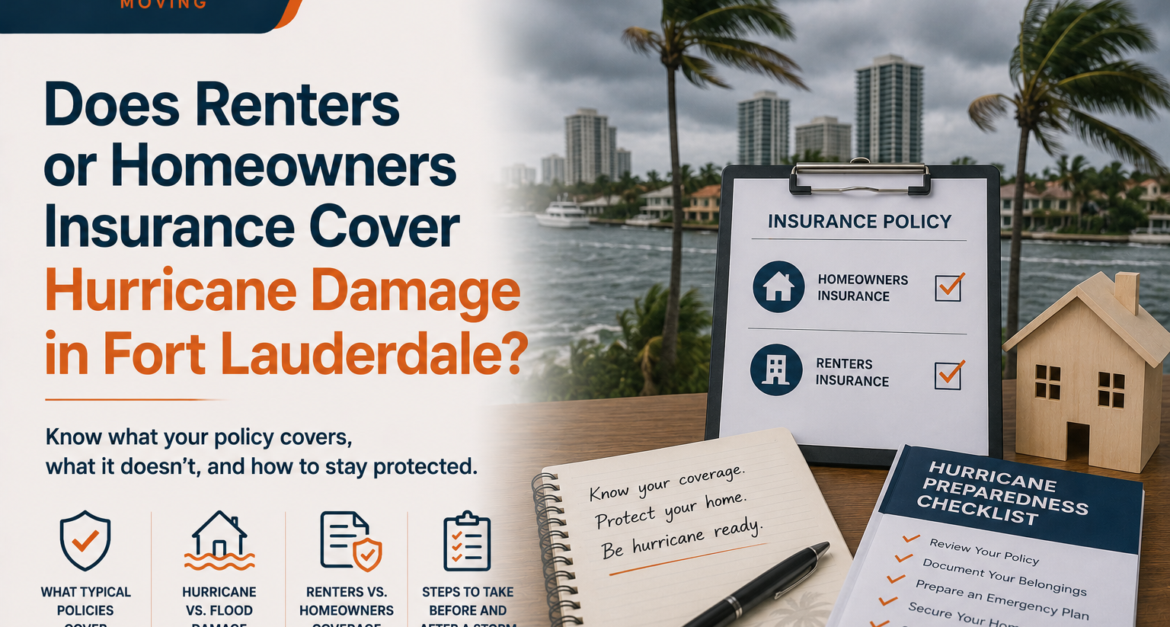
- Standard renters and homeowners insurance covers wind damage from a hurricane, but not flood damage; those are two separate policies.
- Flood insurance is sold separately through the National Flood Insurance Program or a private carrier, and it is not automatically bundled with your lease or homeowners policy.
- Belongings in transit during a move are usually not covered by renters insurance; that is a moving company’s valuation coverage or a separate mover’s insurance policy.
- Coverage gaps show up most often at the exact moment people move, when boxes sit in a garage, a POD, or a storage unit before hurricane season peaks.
- Confirming coverage before your move date, not after a storm warning, is the only way to avoid a denied claim.
Moving to Fort Lauderdale means moving into a hurricane zone, whether your move happens in July or January. Insurance is one of the least exciting parts of relocating, but it is also one of the most expensive things to get wrong. Every year, people find out the hard way that their renters policy does not cover flood damage, or that their belongings were not protected during the two weeks they sat in a storage unit between move-out and move-in. Here is what actually gets covered, what does not, and where the coverage gaps tend to open up during a move.
Wind Damage vs. Flood Damage: The Distinction That Matters Most
This is the single most misunderstood part of hurricane insurance, and it catches new Florida residents constantly. A standard renters or homeowners policy covers wind damage. If a hurricane tears the roof off your building or shatters a window and rain gets in through that opening, that is typically a covered wind event.
Flood damage is different. If water rises from the ground, from storm surge, from an overflowing canal, or from general flooding, that is excluded from a standard policy. Flood coverage has to be purchased separately, either through the National Flood Insurance Program or a private flood insurance carrier. In a coastal city like Fort Lauderdale, where storm surge and heavy rain flooding are real risks in low-lying neighborhoods, skipping flood coverage because you assume your renters policy “covers hurricanes” is one of the most expensive assumptions a new resident can make.
Before you sign a lease or close on a home, ask directly: does this policy include flood coverage, or do I need to buy it separately? Get the answer in writing.
What Renters Insurance Actually Covers
Renters insurance protects your personal belongings, not the building itself, that is the landlord’s responsibility through their own policy. A typical renters policy in Fort Lauderdale covers:
- Personal property damage from wind, fire, and most named perils
- Liability if someone is injured in your unit
- Additional living expenses if your unit becomes uninhabitable and you need temporary housing
- Personal property theft
What it typically excludes:
- Flood damage, including storm surge
- Damage to your belongings while they are in transit during a move
- Damage from long-term neglect, such as unaddressed roof leaks
Many Fort Lauderdale buildings and landlords now require proof of renters insurance as a lease condition, so this is not really optional even if it were not a smart idea on its own merits. It is also inexpensive relative to homeowners insurance, since it is only covering your possessions and liability, not a structure.
What Homeowners Insurance Covers, and Where It Falls Short
If you are buying rather than renting in Fort Lauderdale, homeowners insurance covers the structure of your home plus your belongings, again excluding flood. Given how much of Broward County sits close to sea level, flood insurance is not a theoretical add-on here, it is close to a necessity, and many mortgage lenders will require it if your home falls within a FEMA-designated flood zone.
Hurricane deductibles also work differently than standard deductibles. Many Florida homeowners policies carry a separate hurricane deductible, often calculated as a percentage of your home’s insured value rather than a flat dollar amount. That can mean a much higher out-of-pocket cost after a hurricane than you would expect from a typical claim. Ask your insurance agent to walk through exactly what your hurricane deductible would look like in dollars, not just as a percentage on paper.
The Coverage Gap That Opens Up During a Move
Here is the part most people never think about until it is too late. Renters and homeowners insurance is written to protect belongings inside a fixed address, your apartment, your house. The moment your belongings leave that address, whether they are on a moving truck, sitting in a storage unit, or staged in a garage before the movers arrive, your homeowner or renters policy typically stops covering them.
That gap matters enormously during hurricane season, because a lot of moving happens in Florida during exactly the months when storms are most active. If your belongings are in a PODS container in a driveway when a tropical storm rolls through, your renters policy back at your old address is not going to help you.
This is where a moving company’s own coverage comes in. Full value protection through your mover is different from renters insurance, it specifically covers your belongings while they are in the mover’s care, in transit, and in short-term storage between pickup and delivery. If your move overlaps hurricane season at all, this coverage is worth understanding in detail before move day, not after a storm forecast appears.
SHORT-TERM STORAGE DURING HURRICANE SEASON
If your move gets rescheduled because of a storm watch or warning, your belongings need somewhere safe to sit in the meantime. A climate-controlled warehouse is very different from a shipping container left outside. Ask any mover you are considering exactly where your belongings go if a move gets delayed by weather, and whether that location is protected against wind and flood risk itself.
| Coverage Type | What It Protects | What It Typically Excludes |
|---|---|---|
| Renters Insurance | Personal belongings, liability | Flood damage, in-transit damage during a move |
| Homeowners Insurance | Structure plus belongings | Flood damage, sometimes limited by hurricane deductible |
| Flood Insurance | Water damage from rising water or storm surge | Wind damage, this is a separate policy entirely |
| Mover's Valuation Coverage | Belongings while in the mover's possession | Damage that occurred before pickup or after delivery |
Questions to Ask Before Move Day
Before your move date, whether that is during hurricane season or not, get clear answers on a few specifics. Confirm whether your new building or landlord requires renters insurance and what minimum coverage they expect. Ask your insurance provider directly whether flood coverage is included or needs to be purchased separately, since this is the single biggest gap people discover after the fact. If your policy has a hurricane-specific deductible, get the dollar estimate in writing rather than relying on the percentage listed in the policy summary. And confirm with your moving company what happens to your belongings, and who is liable for them, if a storm delays your move.
Final Thoughts
Hurricane insurance in Fort Lauderdale is not complicated once you understand the two separate categories, wind and flood, but it is easy to assume you are covered when you are not. The coverage gap that opens up specifically during a move, when belongings are in transit or short-term storage, is the part almost nobody thinks to ask about until something goes wrong. Confirming coverage before your move date, rather than during a storm watch, is the difference between a minor inconvenience and a real financial loss.
If you are planning a move to Fort Lauderdale and want a mover who already plans around hurricane season instead of getting caught off guard by it, our Fort Lauderdale movers team builds flexible scheduling and storage options into every quote from day one.
Frequently Asked Questions
Yes, if you want protection against flood damage. Standard renters and homeowners policies exclude flooding, including storm surge, regardless of what causes it.
Often, yes. Many Florida homeowners policies include a separate hurricane deductible calculated as a percentage of your home’s insured value, which can be significantly higher than a standard deductible.
That depends on your moving company’s storage arrangements. Ask specifically where belongings are stored during a weather delay and whether that location has climate control and storm protection.
Many buildings require proof of coverage as a lease condition, and having it active from day one avoids any gap in protection during the move itself.