





By Boris Svirsky, Owner & Founder, Safeway Moving
Why the Trap Never Lets Go
I want to tell you something I didn’t fully understand until I’d been in this business about a decade.
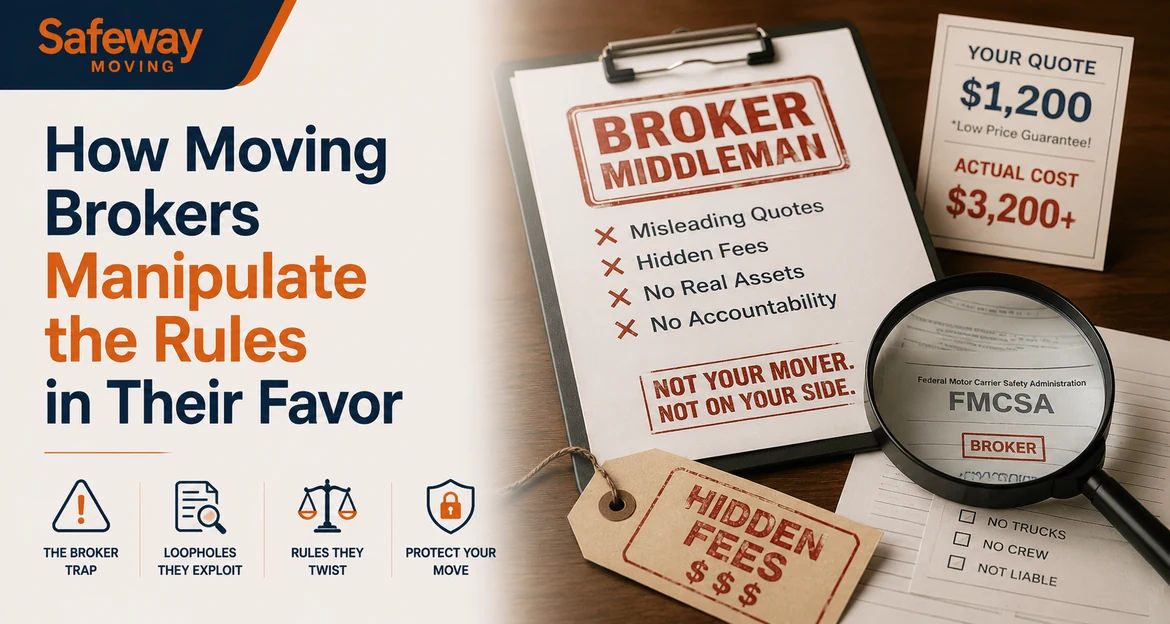
A broker doesn’t own a truck. A broker doesn’t employ a single mover. A broker sells your job to a carrier, takes a cut, and steps back. They are a completely separate legal entity from the company that shows up at your door. That is genuinely different from a major van line with an agent network, which people conflate all the time. In an agent network, everything stays under one umbrella, the insurance, the valuation coverage, the claims process, the reputation. One name is on the hook. With a broker, the name that sold you the move and the name on the truck have no such relationship. They have an invoice between them.
I want to be fair here, because the loud version of this argument is wrong and you should be suspicious of anyone who makes it. Most brokers are not villains. The large ones spend real money on advertising and they do not wake up in the morning hoping to ruin your week. They would genuinely prefer you had a good move. It’s better for them if you do.
The problem isn’t their character. The problem is arithmetic, and arithmetic doesn’t care about anyone’s intentions.
A broker cannot get major-league carriers. Not consistently, not at scale. The best operators fill their trucks with their own sales, at their own prices, with their own margin intact. They don’t need to buy work at a discount from a stranger. So the broker’s available roster is, by simple process of elimination, restricted to the college and semi-pro tiers I broke down here.
Here’s what a two-truck operator actually lacks. Not effort. Not, usually, willingness. He lacks demand. He has no sales floor, no marketing budget, no brand anybody’s heard of, and no realistic path to building any of it while making payroll on Friday. The broker solves that problem instantly, he picks up the phone and there’s work on it.
So he takes the job. At a rate with no margin in it, because that’s the rate on offer, and an empty truck earns nothing at all. He gets it done by squeezing the only thing left to squeeze: labor, materials, care, and the customer standing in the driveway. He survives the week. And then he does it again. What he never does, what he cannot do, because every dollar is spoken for before it arrives, is build the sales operation that would let him stop.
I know this trap because we nearly walked into it ourselves. When we started Safeway, we spent about six months operating as a broker, trying to do it the honest way, giving carriers fair prices and real volume, never sending out an underquoted job. And the carriers still couldn’t be serious operators. Not because we treated them badly. Because the economics of their side of the transaction had already decided what kind of company they were allowed to be. We understood then that there was no clever version of this. So we bought trucks and put every dollar and every hour into doing it ourselves.
I saw the other side of it too, years earlier, at a company with ten tractor trailers and two locations where roughly seventy percent of the work came from brokers. Every job arrived with a balance too thin to survive on. So the company hired foremen for a specific purpose, not to run the move, but to revise it. To get to the customer’s driveway, find the extra items, and bring the job back up to profit. Their four recurring complaints, every single week, were delivery delays, broken items, missing items, and price. The only four things that actually matter in a move.
The Five Thousand Dollar Move
Let’s do the actual arithmetic. Denver to Tennessee, two-bedroom home.
A real carrier, one that owns the truck, employs the crew, and performs its own delivery, is going to quote you somewhere around $6,500. There’s a genuine cost structure underneath that number: labor, fuel, trucks, warehouse, insurance that goes up every year whether you like it or not, claims, and the boring back-office machinery that makes a shipment findable at 9pm on a Sunday.
A broker quotes you $5,000. That’s the hook. Then the broker takes their cut off the top. Many take forty to fifty percent as a deposit. So $2,500 goes onto your credit card, and $2,500 is the balance, the entire budget for physically moving your home across the country. There is no carrier in America who can perform that move properly for $2,500. That job goes to college ball, the operator with no other source of work, who takes it because an empty truck earns nothing, and who has already worked out how he’s getting the money back. He’s going to get it from you. In your driveway. On the morning of your move.
What Happens on the Driveway
The foreman arrives. His actual job, the one his commission is built on, is to bring the job back to profit before the truck leaves. He reviews your inventory and revises the contract right there, before loading, pointing to a handful of items that weren’t on the broker’s list. And here’s the uncomfortable part: he’s often partly right. There usually are a few extra items. The broker’s list was thin because the broker never did a serious survey, they quoted you fast and cheap to win the booking.
A post-load price adjustment isn’t automatically a scam, it happens at legitimate companies too, especially on full-pack moves. The difference is what the company does about it. A real operator who under-quoted your packing will eat most of it and discount the rest, because the relationship and the review are worth more than the delta. A carrier working a broker’s job at zero margin cannot afford that gesture. Not because he’s worse, because he’s broke.
The Tricks, Plainly
Cubic feet versus items. Most companies working broker jobs bill by the space your shipment occupies as stacked on their truck. Their revenue is a direct function of how badly they stack. Your goods measure a thousand cubic feet; loaded sloppily, they take twelve hundred; you’re billed for twelve hundred.
Double-stickering. Inventory tags get applied more than once to the same piece, so a shipment of ninety items becomes a shipment of a hundred and twenty. You won’t notice on load day.
Selling air. Straps used to create hidden dead space between stacks, so the truck reads fuller than it is.
Federal regulation requires a mover to write an inventory of everything in your shipment and assign each item an identification number. The sticker book isn’t just shady, done that way; it’s a compliance question. Ask about it.
The Deposit, the Bill of Lading, and the Window You Don’t Know You Have
This is the most valuable thing in this piece, so read it twice.
Under current federal rules, you have the right to cancel your move without penalty, right up until the bill of lading is signed. The bill of lading is the contract. It’s the moment the deal becomes real.
Here’s what you need to understand about how this plays out: the bill of lading now arrives early. Often the same day you book. You’ll get the estimate, and then, sometimes within the hour, a bill of lading lands in your inbox alongside it, and somebody warm and encouraging asks you to sign so they can lock in your dates. Once you sign, your penalty-free window is over.
With a broker, you may be signing something strange, a blank bill of lading, or one belonging to a carrier you’ve never heard of, have never researched, and did not agree to. You are, at that moment, entering into a contract with a company you cannot name.
Do not sign anything on booking day. Read every document. Ask directly which company’s bill of lading you are being asked to sign, and who is actually going to show up. If nobody will answer that plainly, you have your answer.
The Four Questions
Ask these on any call, before you book. Listen for whether they can answer without a script.
- How do you make sure my items don’t go missing? Listen for a system, item-level tracking, scanning, custody at each transfer. Not reassurance.
- How do you make sure my things arrive in a reasonable window? The real question underneath it: do you perform your own delivery, or hand it to a third party?
- How do you keep things from being damaged? Ask about training. Ask how long a new crew member works under supervision before touching your furniture alone.
- What happens if the price changes? Ask exactly what triggers a revision, who has authority to do it, and what happens if they got the quote wrong.
If a company can’t have that conversation, if they steer you back to the price every time, don’t spend your money there.