





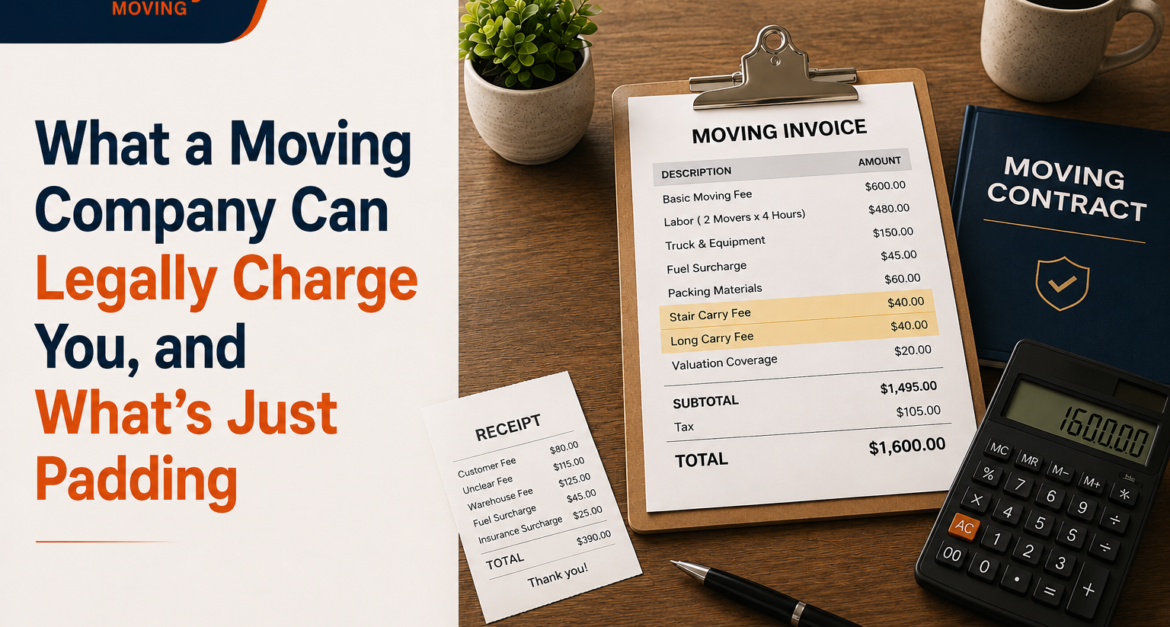
Origin fee. Destination fee. “Handling.” Half of these are real. Half exist to inflate your quote. Here’s how to tell them apart, from someone who writes them for a living.
By Boris, Owner, Safeway Moving
When your moving quote grows, it almost always grows through fees, the extra line items stacked on top of the base price for weight and distance. Some of those fees are completely legitimate. Some are pure padding invented to fatten the number. The problem is they can look identical on paper, and most people don’t know which is which until move day, when it’s too late to argue.
I price moves for a living. Let me show you the actual, finite list of what a mover can legally charge you extra for, why a real “origin/destination” charge sometimes exists, and how to spot the fake version that shows up on scam quotes, and doubles the moment the bait and switch hits.
The golden rule: if it’s not in the tariff, it can’t be billed
Every legitimate moving company operates under a tariff, a formal, legally required price list of every charge it’s permitted to apply. This is the single most powerful fact most consumers never learn: a fee that does not appear in the mover’s tariff cannot lawfully be billed to you. That one sentence turns a vague argument on moving day into a simple question, “show me where this is in your tariff”, that a scammer usually can’t answer.
So when you see an extra charge, you’re really asking two things: is it a real, tariff-defined service, and was it triggered by something real about my move?
The legitimate extras, and every one has a trigger
Here’s the short list of accessorial charges a real mover can apply. Notice that each one exists because of a specific, physical reality about your home or your belongings. They are trigger-based, not random:
- Long carry: when the truck can’t park within a set distance of your door (commonly around 75 feet), so the crew has to haul everything farther.Typically billed in distance increments.
- Shuttle: when a full-size truck physically can’t reach your street or building, so your goods are transferred to a smaller vehicle for the last stretch. Common in dense cities and on narrow or steep driveways.
- Stairs/elevator: flights of stairs beyond the first, or the time and coordination of a building elevator and its reserved move-in window.
- Packing materials and labor: boxes, paper, tape, and the crew time to pack fragile or bulky items, if you’ve asked them to pack.
- Bulky / specialty handling: pianos, safes, gun safes, pool tables, large appliances, fine art: items that need extra equipment or people.
If a charge on your quote maps to one of these and matches your actual situation- you do have three flights of stairs, your street is too tight for a trailer- it’s real. Tell your mover about these conditions up front so they’re included in the written estimate rather than as a “surprise” on move day.
Where origin/destination fees get legitimate, and where they don’t
Now the fee that causes the most confusion, because it lives on both sides of the line: the origin/destination (OD) charge.
A legitimate OD charge exists because labor genuinely costs different amounts in different places. In certain regions, local wage laws, permit requirements, or access conditions make it more expensive to staff a crew at your pickup or your delivery. A serious carrier that knows its real costs will apply a modest, specific adjustment, often a few hundred dollars, to cover that genuine difference. It’s honest math tied to a real cost.
The scam version wears the same name and means nothing of the kind. A broker who owns no trucks and has no idea what labor actually costs in your city uses “OD fee” as a catch-all, a number with no service behind it, dropped onto the quote purely to inflate it. And here’s the tell that gives it away every time: when the bait and switch arrives a few days before your move, watch the OD fee “magically” double right alongside your suddenly larger inventory. A fee tied to a real cost doesn’t behave that way. A fee that was never real does.
The fees to be suspicious of
Some line items deserve a hard second look, because they’re the ones most often used as padding:
- Vague “fuel” or “supply” surcharges with no defined basis. Fuel surcharges can be legitimate, but they should be a stated percentage or formula, not an arbitrary lump.
- An “OD fee” with no explanation of the specific regional cost it covers.
- “Handling” or “difficulty” fees that aren’t tied to a named, physical item or condition.
- Storage-in-transit charges that appear because the mover’s scheduling delayed your delivery, you shouldn’t be paying daily storage for their logistics problem.
How to shut the padding down
- Get every possible accessorial fee itemized in writing before you sign, including the “worst case” ones like shuttle or long carry, so nothing can be invented later.
- For each fee, ask one question: “What specific service does this pay for, and is it in your tariff?” Real fees have a clean answer. Padding doesn’t.
- Disclose your conditions up front: stairs, tight streets, long driveways, an elevator, heavy specialty items. This is your protection, not theirs: it forces the real fees into the estimate instead of leaving room for surprises.
- Get a binding or binding not-to-exceed estimate. A binding estimate locks your price for the listed items and services; not-to-exceed means you pay the estimate or the actual cost, whichever is lower, never more.
A fair mover wants to quantify these fees for you up front, because a clean, honest quote is how we keep customers and reviews. The company that gets cagey when you ask, “What is this fee for?” is answering your question by refusing to answer.
Boris is the owner of Safeway Moving, a national carrier that itemizes every charge in writing before you sign. Get a transparent quote from state-to-state movers who itemize every fee.