





Key takeaways
- Furniture damage on a long-haul move follows four consistent patterns: friction, impact, joint and hardware stress, and environmental exposure, and all four get worse the longer and farther the shipment travels.
- Most physical damage happens during loading and unloading, not on the highway, which means the number of handoffs matters more than the total distance.
- A 2,800-mile move with one crew from pickup to delivery carries less risk than a shorter move that changes trucks or crews partway through.
- Temperature swings and humidity, especially on a coast-to-coast route crossing desert, mountain, and Midwest climates, can warp wood and affect finishes if furniture isn’t wrapped to let moisture escape.
- Secure strapping, individual padding, and breathable wrapping address each risk category directly, rather than relying on generic “careful packing.”
- Safeway Moving uses one crew from pickup to delivery on long-haul corridors, with barcode tracking that documents condition at both ends.
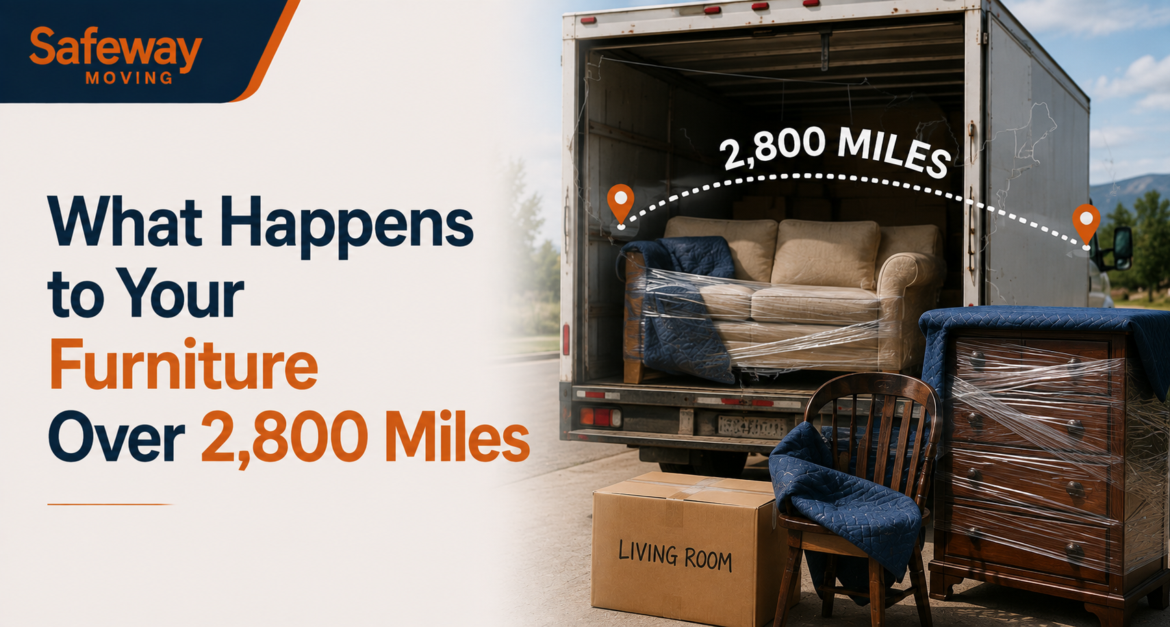
Your dresser leaves Los Angeles on Monday. It crosses the Mojave, climbs through the Rockies, rides through Kansas heat and a Midwest thunderstorm, and if it’s headed to New York, it doesn’t see a loading dock again until sometime the following week. That’s not a hypothetical; it’s roughly what a 2,800-mile move actually puts a piece of furniture through, and understanding it is the difference between packing for a move across town and packing for one that takes the better part of two weeks.
The Four Things That Actually Cause Damage
Furniture damage during a long-haul move isn’t random. It follows four consistent patterns, and every one of them gets more severe the longer the trip runs.
Friction: Anything that rubs against another surface for hundreds of miles picks up scuffs and scratches that a short drive would never produce. A glossy finish or a piece of glass shows this fastest, but even solid wood dulls under enough sustained contact.
Impact: Most physical damage doesn’t happen on the highway, it happens during loading and unloading, when large pieces get maneuvered through doorways, stairwells, and truck ramps. On a route with only one pickup and one delivery, that risk is contained to two events. On a route where the shipment gets transferred between trucks or crews, every additional handoff is another chance for a corner to catch a door frame.
Stress on joints and hardware: Road vibration compounds over distance and time. A short move barely tests a chair’s joinery. A multi-day haul on interstate highways puts sustained, repetitive stress on exactly the weak points- legs, joints, drawer glides- that hold furniture together, which is why loose hardware and cracked joints show up disproportionately on longer routes.
Environmental exposure: This is the one people underestimate most, and it matters more on a coast-to-coast route than almost anywhere else. A shipment crossing from Los Angeles to New York moves through desert heat, mountain temperature swings, and Midwest humidity, sometimes all in the same week. Wood absorbs moisture and can swell or warp. Extreme heat can affect finishes and adhesives. A truck that sits parked in direct sun during a fuel stop can push interior temperatures well above what any piece of furniture was built to handle for hours at a time.
None of these four are exotic risks. They’re the same four causes of damage on every move, everywhere. What changes on a 2,800-mile route is exposure, more miles of friction, more transit time for vibration to compound, more climate zones to cross, and on some carriers, more handoffs where impact damage happens.
Why the Number of Handoffs Matters More Than the Distance
Distance alone doesn’t determine risk the way people assume. A 2,800-mile move handled by one crew from pickup to delivery is, in practical terms, safer than a 500-mile move that changes trucks twice. Every transfer point is a moment where furniture gets moved by a different set of hands, on a different truck, loaded by a crew that didn’t pack it the first time and doesn’t know how it was secured. This is one of the real, practical reasons the carrier versus broker distinction matters beyond pricing: a brokered shipment that gets subcontracted to a different carrier partway through the route adds exactly the kind of handoff that multiplies impact risk, on top of the accountability problems that come with it, something covered in more depth in how brokers manipulate the rules around subcontracting and disclosure.
On corridors like California to New York, New York to Los Angeles, and California to Florida, all genuinely long hauls in Safeway’s own route network, the same crew that wraps and loads your furniture is the one that unloads it, with no hand-off in between.
What Actually Reduces the Risk
A few specific practices address each of the four risk categories directly, rather than treating “careful packing” as one vague catch-all.
Against friction: furniture gets individually wrapped in moving blankets or padded covers as part of Safeway’s packing services, not stacked directly against other pieces or the truck wall. Padding absorbs the rubbing that would otherwise wear into a finish over hundreds of miles.
Against impact: proper lifting technique and door-frame awareness at pickup and delivery, the two moments where most physical damage actually happens, plus a barcode-scanned inventory at both ends so any impact damage gets caught and documented immediately rather than discovered days later.
Against joint and hardware stress: secure strapping inside the truck so furniture can’t shift during transit, since unsecured pieces absorbing road vibration for a full week put far more cumulative stress on joints than the same vibration hitting a properly tied-down load.
Against environmental exposure: breathable wrapping rather than fully sealed plastic, which traps humidity against wood and leather instead of letting it dissipate, along with a loading strategy that keeps heat-sensitive pieces away from direct contact with hot metal truck walls during long stretches in summer conditions. If a delivery date slips and items need to sit for a few weeks before the final leg, storage-in-transit that’s climate-aware matters here too, not just the drive itself.
If Something Does Happen Anyway
Even with every precaution taken, damage occasionally happens; that’s the honest reality of moving anything a few thousand miles. What matters then is whether there’s a clear record of the item’s condition before it left your home and a straightforward process for resolving it. A barcode-scanned inventory creates exactly that record automatically, and knowing what the claims process actually looks like before you need it is worth reading regardless of which mover you choose.
Frequently Asked Questions
Longer routes increase exposure to the same four risk factors, friction, impact, vibration, and environmental conditions, simply because there’s more time and distance for each one to compound. The precautions that prevent damage are the same either way, they just matter more the longer the trip runs.
Yes. Wood absorbs moisture and can swell or warp with sustained humidity exposure, and extreme heat can affect finishes and adhesives, particularly if a truck sits parked in direct sun for extended periods during a multi-day route.
Every transfer point adds another loading and unloading event, which is when most physical damage actually occurs, plus a different crew handling items they didn’t originally pack or secure.
The same crew that loads your shipment delivers it, with no third-party handoff. Furniture is individually padded, secured against shifting during transit, and barcode-tracked from pickup to delivery.