





By Boris Svirsky, Owner & Founder, Safeway Moving
I’ve spent over twenty years in this industry, working for seven different moving companies before building my own. And I want to tell you something almost nobody in this business will say out loud: the marketing has almost nothing to do with the moving. The companies with the best websites are frequently the worst at the actual work. Beautiful branding, gorgeous trucks, and a warehouse full of guys nobody ever bothered to train.
So let me explain how to actually tell the good ones apart from the rest, because once you can see the difference, the whole industry stops being confusing.
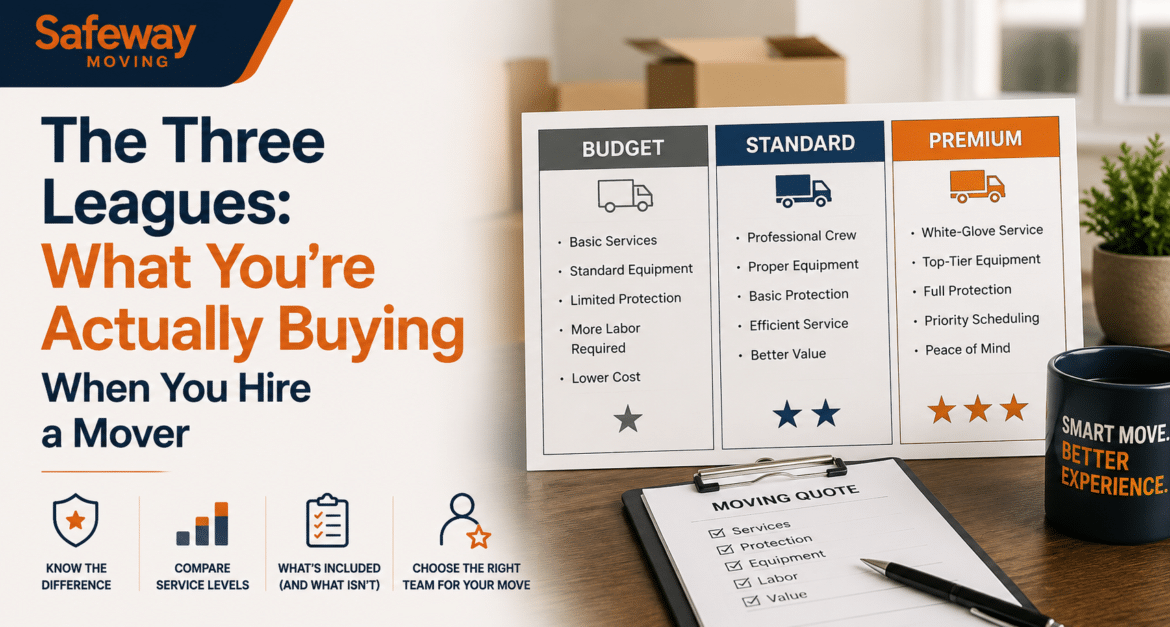
There Are Three Leagues in Moving
Forget the logos. Forget the reviews for a second. Every moving company in America falls into one of three tiers, and once you can tell them apart, the entire industry stops being confusing. I like to use baseball as a reference here, it’s the common American pastime, and the tiers translate cleanly to just about any service-based business. But I use three tiers instead of two for one specific reason: college ball is not professional. Not a lesser kind of professional. Not professional-adjacent. Not professional.
What “Professional” Actually Means in This Trade
Before the tiers, you need the scorecard. Because “professional mover” is a phrase anyone can print on a truck, and almost nobody earns it.
A professional moving operation has to be competent at all of these, not some of them:
- Packing: knowing which carton, which cushioning, which items can never touch each other, and how a box behaves at the bottom of a stack six high.
- Wrapping and protection: pad-wrapping technique, corner protection, floor and doorway protection, and the discipline that nothing leaves the home exposed.
- Disassembly and assembly: beds, sectionals, cribs, treadmills, wall units, and knowing when a piece needs a specialist instead of a screwdriver and confidence.
- Crating and specialty handling: marble, glass, stone tops, art, pianos, safes. The things that end careers.
- Training: an actual program with supervised reps, not a t-shirt and a start date.
- Loading and load planning: weight distribution, tiering, decking, securing a load that will be on a highway for four days.
- Inventory and item-level tracking: every piece identified, recorded, and traceable at every transfer of custody.
- Dispatch: real routing, real scheduling, and knowing at any hour where a shipment physically is.
- Delivery performed in-house: not handed to a stranger at the far end.
- Claims and resolution: a department, a process, and money set aside for the days it goes wrong.
That’s the trade. Ten disciplines, and the customer only ever sees two or three of them. Master all of them and you’re a professional. Master six and you are a well-intentioned amateur with a truck, and the four you skipped are exactly where your customer’s move is going to break.
The reason the top league is small, genuinely, nationally small, is that assembling all ten takes years of capital, training, and mistakes you pay for yourself. It is a hard club to get into. That’s not marketing. That’s just the math of the thing.
College Ball
Two trucks. Maybe three. A guy with authority, a phone, and a rotating cast of labor who found the job three days ago.
Here’s who this usually is, and I say it without contempt: a guy who worked for a moving company, was good on a truck, decided he could do it better himself, and went and got his own authority. That’s an admirable instinct. It’s how most businesses start.
But look at the scorecard. He probably brought two or three disciplines with him, he can wrap, he can load, maybe he can pack. He has no training program because he is the training program. He has no dispatch because dispatch is his phone. He has no inventory system because he has a pad of stickers. He has no claims department because there is no department of anything. And he has no delivery network, so your shipment gets handed to whoever’s headed that direction.
These are not bad people, necessarily. Plenty of them work hard. But they are not professionals, in exactly the way a college shortstop is not a professional, and the distinction is not snobbery, it’s consequences. Can they wrap a dresser? Sometimes, genuinely well. Will something go wrong across the whole arc of your move? Almost always. Not out of malice. Out of the simple fact that nobody built the other seven disciplines underneath them.
Items go missing at this level with grim regularity, week over week, because nothing is tracked properly. Deliveries run late because they don’t perform their own deliveries. And when it goes wrong, there is no department to call. There’s a guy. And the guy is driving.
The Minor Leagues, Semi-Pro
Six or seven tractors. A real office. Processes that are actually improving. The operator is making a decent living and genuinely wants to move up.
Run the scorecard again. Semi-pro will have six or seven of the ten. They’ve got training of a sort, a week, a mentor, something. They’ve got a dispatcher. They’ve got a warehouse and an inventory process. What they’re usually missing is the expensive end: in-house delivery across the country, real specialty crating, item-level tracking that survives a transfer, and a claims process funded to actually pay people.
Missing three or four disciplines is not a rounding error. It’s precisely the difference between a move that goes well and a move that goes well until the day it doesn’t, at which point you discover there was never anybody whose job it was to fix it.
The Majors
All ten. That’s the definition. Not most of them, not the visible ones, all ten.
Own crews. Own trucks. Own deliveries. A training program measured in months rather than an afternoon. Item-level tracking that survives a breakdown in Nebraska. Real crating for the pieces that deserve it. A claims department with authority and a budget. Dispatch that can tell you where your shipment is at nine on a Sunday night. And enough margin built into the job that nobody on the crew has any incentive to squeeze you in a driveway.
That’s it. That’s the whole definition. It has nothing to do with how big the ad budget is, and it is why this league is small, and why the companies in it don’t need to buy work from anybody.
Why This Matters Before You Book
You wouldn’t hire a semi-professional roofer because he came in two thousand dollars under. You know exactly how that ends: it ends in a ceiling stain in fourteen months and a second contractor charging you to undo the first one’s work. You wouldn’t hire a semi-professional appliance guy to save two hundred dollars, the man who’s read a couple of articles about your dishwasher, because you understand instinctively that you’re going to be paying somebody else to fix it properly in the spring.
Your entire household is heavier, more fragile, and considerably harder to replace than a dishwasher. Before you book your next move, ask which league you’re actually buying into. Read more about my own experience on the other side of this industry and how brokers exploit exactly this gap.
Ready to Book With a Major League Mover?