





Key takeaways
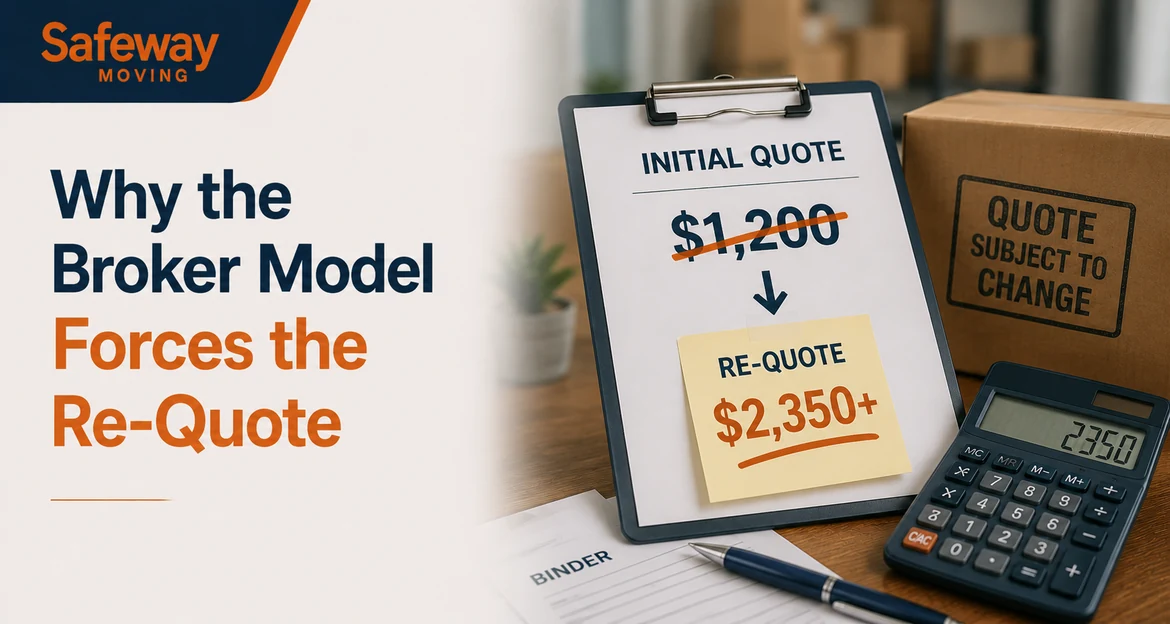
- The broker who quotes your move and the carrier who actually performs it are two different companies with two different incentives, and that gap is the entire mechanism behind the re-quote.
- Brokers are paid for the booking regardless of final cost, so a low, unsurveyed estimate wins the job. The carrier who inherits it is paid by actual weight or volume, discovered for the first time at pickup.
- Federal investigators call this weight bumping, deliberately underestimating a shipment to win the booking, then inflating the weight or volume once belongings are already loaded.
- A non-binding estimate can legally change with actual weight. A binding estimate locks in the price only if built from a real survey. A binding not-to-exceed estimate can go down but never up, the strongest protection available.
- Checking a company’s USDOT number directly in the FMCSA database, entity type and broker authority status, is the fastest way to know whether you’re dealing with a carrier or a broker before you book.
- Safeway Moving is registered as a carrier, not a broker, so the number in your quote comes from the company actually performing the move.
The story is familiar enough that it barely needs repeating: a shockingly low quote online, a truck that shows up weeks later with different branding than the website promised, and a number at pickup that’s suddenly hundreds or thousands of dollars higher than what was agreed. Most coverage of this treats it as a trust problem, a bad actor cutting corners. It’s not just that. It’s a structural feature of how the broker business model actually works, and understanding the mechanism is what makes it possible to spot before you’ve signed anything.
The Quote and the Move Are Given by Two Different Companies
A moving broker doesn’t own trucks, doesn’t employ movers, and doesn’t perform your move. What a broker does is collect your information, give you a price, take a deposit, and then sell your job to an actual carrier, a company you never chose, never vetted, and often never even hear the name of until moving day. The broker gets paid for making the booking. The carrier gets paid for doing the labor. Those are two different companies with two different incentives, and the quote you agreed to was set by the one that isn’t actually going to move your belongings.
That single fact is the entire mechanism behind the re-quote.
Why the Carrier Has Every Reason to Raise the Number
The broker’s original estimate is usually given over the phone or online, without an in-home or virtual survey, based on a rough guess at your inventory’s weight or cubic footage. Under federal law, a mover with a physical location within 50 miles of your home is required to offer a real survey before issuing a binding estimate. Brokers skip this constantly, because a fast, low number is what wins the booking in the first place. A more accurate, higher estimate would just lose the job to a competitor willing to lowball harder. A quote built on real inventory data, the kind you get from an actual moving cost calculator that asks about your specific rooms and belongings rather than a vague phone estimate, tends to land much closer to the real number from the start.
Once that low number has done its job and won your business, the broker hands the shipment to a subcontracted carrier who never set that price, never agreed to it, and isn’t compensated based on it. That carrier gets paid according to what your shipment actually weighs or how much space it actually takes up on the truck, figures they establish for the first time when their crew shows up at your door. If the broker’s original guess was too low, and it usually is, the carrier’s crew has both the opportunity and the financial incentive to “discover” a higher number right there on moving day, after your belongings are already being loaded, your lease has already ended, and you have essentially no leverage to walk away.
This is what the moving industry and federal investigators call weight bumping, and the Department of Transportation’s own Inspector General lists deliberately underestimating a shipment specifically to lure customers, followed by an inflated weight or volume figure at pickup, as one of the primary forms of household goods moving fraud they investigate. It isn’t a rare exception. It’s a predictable outcome of a business model where the company that sets the price and the company that gets paid are never the same company.
The Contract Language That Actually Protects You
Not every estimate carries the same risk, and the difference comes down to three specific terms worth knowing before you sign anything:
- Non-binding estimate: The price can legally change based on your shipment’s actual final weight. This is the version that makes a re-quote enforceable rather than a scam; the fine print technically allows it, even though the number was never accurate to begin with.
- Binding estimate: The price is fixed regardless of actual weight, but only if it was built from a real inventory, not a phone guess. A broker offering a “binding” quote without ever surveying your belongings isn’t offering a real binding estimate.
- Binding not-to-exceed: The strongest protection available. The price can go down if your shipment weighs less than estimated, but it cannot go up, no matter what the carrier discovers at pickup. This single phrase, in writing, is what removes the entire re-quote mechanism from the equation.
If a company won’t put “binding not-to-exceed” in writing, or can’t explain the difference between the three when asked directly, that’s worth treating as a real answer in itself.
How to Tell If You’re Looking at a Broker Before You Book
The FMCSA’s own database lets you check a company’s registration directly, and the distinction matters more than most people realize when comparing quotes for out-of-state movers. Look up the USDOT number and confirm whether the entity type shows as carrier or broker, and whether broker authority is listed as none. A company that’s a broker isn’t automatically dishonest, there’s nothing inherently wrong with the model itself, but it does mean the quote you’re getting was set by a company that won’t be the one performing your move, which is precisely the gap the re-quote lives in.
This particular scam is closely related to a handful of other broker tactics worth understanding together rather than in isolation, and spotting a broker scam before you book covers several of those adjacent red flags in more depth.
Safeway Moving’s Position in This
Safeway Moving is registered with the FMCSA as a carrier, not a broker, for every move it books. There’s no third-party hand-off, no subcontracted crew showing up with different branding than what was quoted, and no separate company setting a price it then isn’t accountable for. The number in your quote comes from the company that actually loads, transports, and delivers your shipment, which is the specific structural gap this piece is about closing. Understanding how brokers manipulate the rules around estimates, subcontracting, and disclosure is worth reading in full if you want the complete picture beyond the re-quote mechanism, and the carrier-versus-broker distinction is worth confirming directly before booking with anyone, Safeway included.
If you want to see how a real, itemized number is built before you ever talk to a sales rep, requesting a quote starts with the same inventory-based process regardless of which company you end up choosing.
Frequently Asked Questions
Because the broker who set the original price and the carrier who performs the move are different companies with different incentives. The broker is paid for the booking regardless of the final cost, while the carrier is paid based on your shipment’s actual weight or volume, which they only measure for the first time at pickup.
Weight bumping is when a mover deliberately assigns a fraudulent or inflated weight or volume to a shipment in order to charge more than the original estimate. The Department of Transportation’s Inspector General lists it as a specific, investigated form of household goods moving fraud.
A non-binding estimate can legally change based on your shipment’s actual weight. A binding estimate locks in the price regardless of weight, provided it was built from a real survey. A binding not-to-exceed estimate can only go down, never up.
Search the company’s USDOT number in the FMCSA’s database and check the listed entity type and broker authority status directly, rather than relying on how the company describes itself.
No. Safeway Moving is registered as a carrier, not a broker, and performs its own moves rather than selling your shipment to a third-party company.