





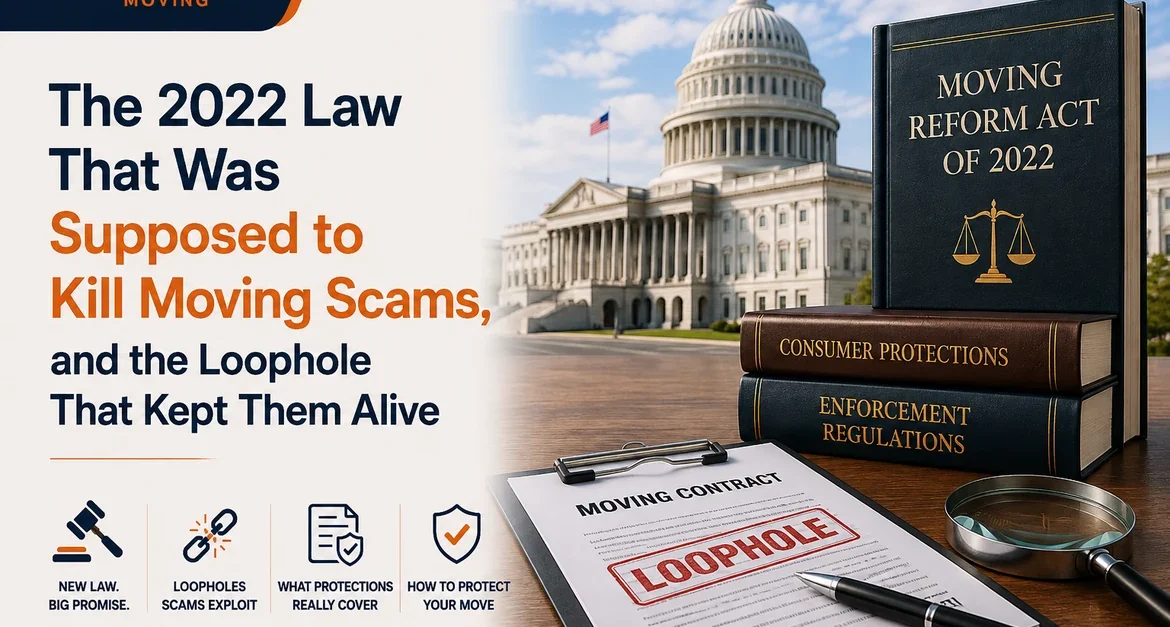
Federal regulators rewrote the rulebook to protect you. The scammers rewrote their script to match. Here’s the new law, the workaround, and the receipts from thousands of real complaints.
By Boris, Owner, Safeway Moving
In 2022, the Federal Motor Carrier Safety Administration did something it hadn’t done in over a decade: it overhauled the consumer-protection rules for interstate moves, with further updates rolling in through late 2023. On paper, the changes should have ended the classic moving scam. New estimate rules. Earlier paperwork. Mandatory surveys.
It didn’t work. Not because the rules are bad, they’re genuinely good, but because a rule that closes one door just tells a scammer which window to climb through next. I run a moving company. I watch the industry adapt in real time. So let me walk you through each protection the law handed you, the exact workaround that now shows up over and over in Reddit threads, Facebook scam-warning groups, BBB complaints, and even federal court records, and how to turn each law back into a weapon in your favor.
First, the scale, so you know this isn’t fringe. The FMCSA received more than 7,500 complaints against movers and brokers in 2022, more than double the number from 2015. The BBB logged nearly 5,900 mover complaints in 2023. And by the government’s own data, 57% of moving-fraud complaints are about overcharges consumers never agreed to. This is the water you’re swimming in.
Loophole #1: They killed the “revised estimate.” So they invented the “confirmation call.”
What the law now says: before 2022, a mover could hand you a “revised estimate” that jacked up your price, sometimes after your things were already on the truck. The new rule eliminated the revised estimate entirely. A mover must now prepare a brand-new estimate before loading begins, and you have to sign it. Re-pricing you on the ramp is out.
The workaround: the ambush didn’t disappear. It moved earlier, to a phone call a few days before your move, right after your 3-day cancellation window quietly closes. It’s dressed up as a friendly “confirmation” or “quality assurance” call. Suddenly your inventory has “grown,” and you’re handed a new estimate, technically legal now, at a dramatically higher price. The relabeling from “revised” to “new” is the entire trick. The law changed the vocabulary; the scam kept the outcome.
The receipts: this isn’t a theory. A federal fraud prosecution documented the exact playbook: once the cancellation period had passed, the operator’s staff would place a “Quality Assurance Check” call, claim there were more items than originally quoted, raise the price, and leave the customer to either cancel and forfeit the deposit or pay up, and then the driver would claim still more weight at pickup. Consumer reviews echo the same rhythm on repeat: a $4,000 quote becoming $9,000 seventy-two hours before the move; prices quadrupling once the truck is loaded.
Your weapon: your 3-day right to rescind runs from the moment you sign the bill of lading, and the law now requires that bill of lading in your hands at least 3 days before your move. So get the itemized inventory in writing at booking and audit it line by line, because the ambush needs a gap between what you own and what’s on paper. Close the gap, and there’s nothing left to “discover.” If a confirmation call tries to re-price you and you never received a compliant bill of lading 3 days out, that’s not a formality they forgot. That’s the tell.
Loophole #2: They can’t make you sign blank forms. So they weaponize your panic instead.
What the law now says: you can never be required to sign a blank document. The bill of lading has to be signed before loading, at both origin and destination, and the old “order for service” is folded into it so everything lives in one place.
The workaround: if you can’t be tricked by a blank form, you can still be rushed into a full one. The scam runs on the clock, re-pricing you days before a hard move-out date, when your lease is ending, and a truck is supposedly booked, so you sign whatever’s in front of you without reading it.
Your weapon: slow down on purpose. Read every line before you sign, out loud if you have to. The law is engineered to give you time; the scammer’s only advantage is convincing you that you don’t have any. You do.
Loophole #3: The law requires a real survey. A phone quote isn’t one.
What the law now says: a mover must conduct a physical survey of your goods, in person, or by live or pre-recorded video, before giving you an estimate beyond a short radius. The old 50-mile exemption is gone, and it applies to brokers too. A number gathered only over the phone or through a web form is not a legally sufficient survey.
The workaround: bad actors love phone-only quotes precisely because a vague inventory is easy to inflate later. But here’s the nuance almost every consumer guide gets wrong: the problem isn’t cubic feet as a unit. Plenty of honest carriers (mine included) price in cubic feet. The problem is what the number is measured against. Honest pricing is per item; add five boxes, you’re billed for five boxes, done. The manipulable version prices by how your stuff stacks in the truck, or “re-measures” the space your shipment takes up once it’s already loaded, a number the crew controls and can inflate on the spot. That’s what the research really points to when it warns that loose volume is easy to upcharge: it was never the cubic foot. It’s the “we’ll finalize it at the truck” that gets you.
Your weapon: insist on a video or in-home survey; if a company won’t do one, they’re skipping a step the law now requires, so walk. Then demand an itemized estimate: every item priced individually, whether that’s expressed in cubic feet or in weight. The unit doesn’t matter; the item-level lock does. Adding five boxes should cost you five boxes’ worth, never “whatever the truck looks like when we’re done.” A binding or not-to-exceed estimate on top of that seals it.
Loophole #4: Brokers used to hide it. Now they weaponize the word.
What the law now says: brokers must display their DOT number, may only quote through carriers they actually have agreements with, and must disclose their deposit, cancellation, and refund policies. They’re required to tell you they’re a broker.
The workaround: this one flipped completely. Brokers used to be nervous to admit what they were. Now they lean into it, hard, with a slick reframe: “everybody’s a broker.” They’ll tell you the big van lines are brokers too, so what’s the difference? Here’s the difference, and it’s the whole ballgame. Established van lines run on interline and agent agreements, a network of vetted agents operating under one carrier’s authority, one brand, and one liability and claims chain. Your shipment never leaves a single accountable system with a name on the door. A pure lead-selling broker does the opposite: they sell your move to an unaffiliated carrier you’ve never heard of and can’t vet, then step out of the way. One is a network under one roof. The other is pass-the-buck. “Everybody’s a broker” is a sentence engineered to blur those two on purpose.
Your weapon: don’t accept the shrug. Ask one question: “If something goes wrong with my shipment, who is legally responsible, you, or another company?” An agent inside a real carrier network answers, “We are, under our authority.” A pass-the-buck broker can’t. Verify carrier vs. broker on the FMCSA database (start at protectyourmove.gov), and understand the nuance the database can’t show you: a branded carrier running an agent network is a different animal from a website that sells your phone number.
Then read the deposit the right way. Size alone isn’t the tell; plenty of legitimate carriers take a real deposit (sometimes up to around 25%) to hold your date and cover the rolling overhead of running actual trucks, crews, and payroll. What separates a booking from a trap is two things: is it refundable, and how are you paying it? A deposit you can get back if you cancel, charged to a credit card (which gives you chargeback protection), is normal business. A large, non-refundable deposit demanded by wire transfer, Zelle, or cash- irreversible money you can never claw back- is the warning. Ask it flat out: “Is my deposit refundable if I cancel, and what’s the window?” Then pay with a card.
Loophole #5: The law got more rules. It didn’t get more teeth.
Here’s the part that should genuinely bother you. The FMCSA rewrote the rulebook, and then told Congress that a 2019 legal decision left it largely unable to assess civil penalties for many of these violations, which has significantly undermined its ability to fight moving and brokering fraud. Meanwhile, the complaints keep climbing, and the agency’s own 2023 enforcement sweeps still turned up more than 1,000 violations.
Translation: the rules on paper are the best consumers have ever had, but the cop often can’t write the ticket. Which leaves exactly one reliable enforcer of your rights. You.
If you still decide to roll the dice: put them on the record
Maybe you’ve read all of this and the broker’s low number still wins. It’s your move and your call, but if you go that route, stop being a victim-in-waiting and become the most documented customer they’ve ever dealt with. The single thing a low-quality operation cannot stand is a smart, organized paper trail.
Here’s the drill:
- Record every call, and tell them you’re doing it. A simple “just so you know, I record all my moving calls for my records” does two jobs at once. It keeps you on the right side of the law (some states require all parties to a call to consent to recording, and announcing it handles that), and it quietly changes how the person on the other end behaves.
- Record the video survey, on the right platform. If they do a video estimate, run it on Zoom or Google Meet and hit record, not FaceTime. This is a five-figure transaction involving everything you own; you want the exact inventory you showed them captured and timestamped.
- Build the paper trail on purpose. Make one dedicated email folder or label, your name plus the company name, and funnel every quote, email, text, and call note into it. When someone calls three days out claiming your inventory “grew,” you’ll have the original video and the original itemized list sitting in one place, ready to quote back.
- Say the quiet part out loud. Tell them up front that you’re recording calls, saving every document, and keeping a log.
The evidence is only half the point. The other half is the filter. Simply announcing that you’ll document everything tells you, almost instantly, how seriously a company intends to take your move. A real carrier shrugs and says “smart, good idea.” A shady one either suddenly gets very careful, or loses interest and stops chasing your booking altogether, because low-quality operators don’t want organized, informed customers. You’re too much work and too much risk to them, and that reaction alone is your first and cheapest test.
These are your life’s possessions. You spent years earning them. Don’t hand them to a stranger without putting a little quiet pressure on the table first.
Your law-powered checklist
- Itemized inventory and bill of lading in writing, the BOL is legally due to you at least 3 days before your move. No BOL 3 days out is a red flag you can act on.
- Demand a video or in-home survey. Phone-only isn’t a legal survey, and it’s the scammer’s favorite tool.
- Verify carrier vs. broker on the FMCSA database before you talk price.
- Get an itemized estimate, every item priced individually (cubic feet or weight, doesn’t matter), locked so five extra boxes cost five boxes’ worth. Binding or not-to-exceed on top.
- Deposit: refundable, paid by credit card. The size matters far less than whether you can get it back, never send a non-refundable deposit by wire, Zelle, or cash.
- Treat any post-cancellation-window “confirmation call” that re-prices you as the ambush it usually is. Your right to a stable, pre-loading estimate is the law.
- Document everything if you use a broker anyway, record calls (and tell them), record the video survey on Zoom or Meet, and keep one folder for every message.
The 2022 rules handed you a better set of tools than any consumer moving across state lines has ever had. The scammers adapted their script within weeks. The good news is that you can adapt yours in a single afternoon, and this article has already done most of it for you.
Boris is the owner of Safeway Moving, a national carrier that runs its own branded fleet and crews, barcodes every inventory item so nothing gets lost, gives you a real survey, and quantifies every fee before you sign. If you’d rather never think about any of this again: get a transparent, itemized quote through a trusted interstate moving company.