





I own a moving company. Here’s the math that forces moving brokers to bait and switch you, and the one habit that makes you nearly scam-proof.
By Boris, Owner, Safeway Moving
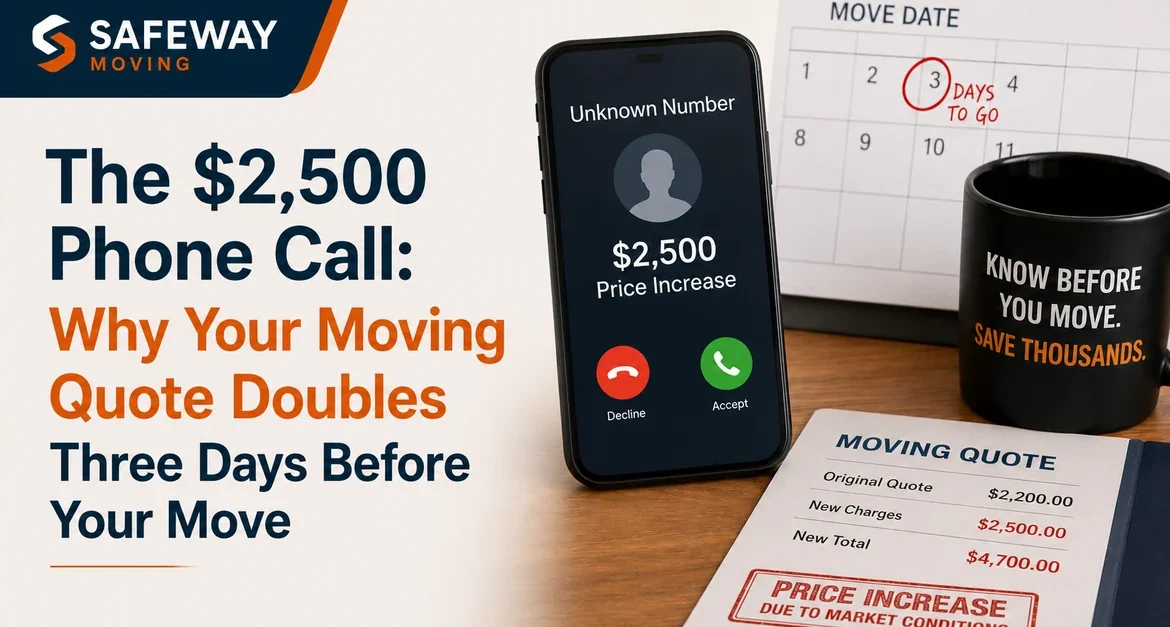
Three days before your move, your phone rings. A friendly voice needs to “confirm your inventory to make sure you’re on the schedule.” Twenty minutes later, your $5,000 move costs $10,000, your deposit is non-refundable, and you have seventy-two hours to either pay up or start over with no mover, no truck, and a lease that ends Friday.
If this has happened to you, you weren’t unlucky. You walked into the single most common trap in the long distance moving industry, and I want to show you exactly how the machine works from the inside, because once you see the math, you’ll understand something almost nobody tells you:
Most of the companies running this play aren’t trying to scam you. They’re trapped in an economic model where they can’t survive without it.
Here’s the uncomfortable nuance. Roughly half of these operators don’t even understand the economics of a move. They’ve never ridden in the truck, never made payroll for a crew, never owned a fleet, so they genuinely don’t grasp that the low numbers they’re selling can’t add up. They don’t realize they’re running a scam until the chargebacks pile up, their credit card processor shuts down their merchant account, and they lose half their money overnight. The other half know exactly what they’re doing. They’re just dirtbags.
That doesn’t make it hurt less. But it does make it predictable, and predictable means avoidable.
First, understand who you’re actually talking to
When you search “best long distance movers,” the companies dominating those ads and “Top 10 Movers” directory lists are overwhelmingly brokers, sales operations that own no trucks, employ no crews, and will hand your move to whichever carrier takes it. Federal regulators have been blunt about the category: FMCSA’s annual enforcement sweep specifically targets brokers that claim to connect consumers to local movers but instead take advantage of consumers and facilitate fraud.
The scale of the problem is not small. In 2022 alone, FMCSA received over 7,500 complaints against moving companies and brokers, more than double the figure from 2015. And by the government’s own historical data, 57% of moving-fraud complaints report overcharges, costs consumers never agreed to.
Overcharging isn’t a bug in this system. It’s the business model. Here’s why.
The math that makes the scam mandatory
I buy advertising in this industry, so let me show you the numbers the friendly voice on the phone will never share.
Those “compare top movers” websites sell your phone number the moment you submit it. A single long distance moving lead costs a broker roughly $150 to $200. But a lead isn’t a customer, it’s a chance at a customer, and with ten companies dialing you within ninety seconds of you hitting submit, a broker connects and closes on maybe one in ten leads.
Do the multiplication. Before a broker earns a single dollar, they’ve spent $1,500 to $2,000 in advertising just to get one person to say yes. The sales rep who charmed you hasn’t been paid yet either.
Now look at your $5,000 quote. The broker takes their money up front, typically 40 to 50% of the total as a “reservation deposit” charged to your card at booking. That $2,000 to $2,500 deposit has to cover the ad spend, the rep’s commission, and the company’s margin, and whatever is left over goes to the actual carrier who shows up with a truck.
See the problem? If your quote were honest, there’d be almost nothing left to pay the people doing the physical work. So the quote can’t be honest. The low number exists to win your credit card; the real number arrives later. I call it double jeopardy: the broker needs to help you to get paid, but their cost structure guarantees they must squeeze you to survive.
And here’s the part that should worry you most, because it’s about quality, not just price. Moving is expensive for the mover, too, the truck, the fuel, the insurance, the tolls, the hotels, and a trained crew cost roughly the same everywhere in the country. Now finish the math: after the broker keeps its deposit, the carrier who actually shows up at your door is working off maybe 50 to 55% of the remaining balance, on a quote that was already cheaper than the national van lines. Ask yourself honestly, with that little money left on the bone, what kind of company takes that job? People who are genuinely good at the four things that matter, driving the truck safely, packing your furniture so it survives, delivering on the date they promised, and not stealing or breaking your things?
There isn’t enough left to pay for that caliber of crew. And that is exactly why the quote has to be revised before pickup: the broker has to claw back the margin it burned winning your booking, and the number has to climb high enough that a real carrier will accept the move without losing money on day one. The ambush isn’t greed stacked on top of a fair deal, it’s the only way the original deal ever functions at all.
Anatomy of the ambush: New York to Dallas
Let me make it concrete, because this exact story plays out every day.
You land a new job in Dallas starting in three weeks. Two-bedroom apartment in New York, roughly 1,200 cubic feet of life. Total budget: $6,000, and that has to cover packing materials, the flight, an Airbnb while you wait for delivery, everything.
You find a comparison site. Within the hour you have quotes clustered around $5,000. Frank from the moving company is warm, reassuring, unhurried. He walks your inventory with you over the phone. You hang up feeling incredible, a massive life problem solved in under sixty minutes.
Here’s what you didn’t see. Frank is under brutal pressure to book before the nine other reps calling you do, so the inventory got built fast, not thoroughly. A couch logged under the wrong size code. The four boxes you mentioned in passing, never entered. And you, relieved, romanced by the number, never read the list line by line. Why would you? Frank sounded so sure.
On a small move, you’d catch it. A studio at 300 cubic feet has maybe two dozen line items; you can audit that in ninety seconds. But a two-bedroom runs 80+ items. Nobody audits 80 items unless they know they need to. The trap lives in the margins, the mislabeled couch, the four missing boxes, precisely because that’s where you’ll never look.
Three weeks later you’re packing and discover you’re over by about ten large boxes. Reasonable. Then the confirmation call comes: those items can’t go on the same truck, it’s already committed to other customers. We’d have to add equipment. Your origin fee changes. Your price is now $10,000.
“All this trouble for ten boxes?” Yes. That was always the plan, the discrepancy just gave it a trigger.
And now the squeeze: cancel and forfeit your $2,500 deposit, then try to find a legitimate mover with three days’ notice at any sane price, or pay the revised deposit on the new $5,000 in charges they just added. The overwhelming majority pay, and find a way to make peace with it. The broker knew they would. The deposit isn’t a reservation. It’s a hostage.
And because a broker’s margins are so thin, this isn’t the occasional bad apple, it’s the recovery mechanism the entire model runs on, the way they claw back the margin they burned to win you. Which is why almost anyone moving more than about 800 cubic feet should simply expect it: above that size there’s enough room in the inventory to conveniently “find” extra volume, and the broker or scam carrier quite literally cannot survive the deal without doing it.
Why nobody’s coming to save you
Here’s the part that should genuinely anger you. The regulator knows. FMCSA runs a nationwide operation every spring targeting exactly this; its 2023 sweeps uncovered more than 1,000 violations. But enforcement has been running with one hand tied: FMCSA itself told Congress that a 2019 administrative law decision found it lacks statutory authority to assess civil penalties for these violations, significantly undermining its ability to combat household goods moving and brokering fraud.
And it isn’t only the regulators who can’t keep up, even the court of public opinion gets played. When a scam operation racks up too many complaints, it doesn’t reform; it rebrands. Many change their company name constantly, and the savvier ones buy up the expired domain names of legitimate movers that went out of business years ago, domains still tied to an old, aged BBB profile. Once they control the domain, they reactivate that dormant BBB account, and overnight a brand-new operation appears to have a decade of history and a spotless reputation. The glowing “10+ years in business” record you’re trusting may belong to a company that no longer exists.
Translation: the cop can pull the scammer over, but mostly can’t write the ticket. Until Congress fixes that, your protection is you.
How to make yourself nearly scam-proof
The good news: because the scam is economic, not clever, it collapses against a few simple habits.
- Read every inventory from every mover, every line, every time. This is the whole ballgame. The ambush requires a gap between what you own and what’s on paper. Close the gap and there’s nothing to ambush. Boring? Absolutely. It’s also a 15-minute task that protects a $5,000 downside.
- Compare volume before you compare price. Here’s an industry truth: our costs are close to standardized. Fuel, labor, truck payments, insurance, the cost of positioning a truck for a long distance pickup, these don’t vary much between legitimate companies. So when three quotes come in and one is 10% lower, don’t look at the price first. Look at the cubic feet or weight on each list. Nine times out of ten, the “cheap” quote is the same price for a smaller, incomplete version of your move.
- Run the U-Haul test. Price what it would cost to rent the truck yourself, buy the fuel, and bribe your friends with pizza. If a full-service quote comes in below your DIY number, someone else’s labor, equipment, insurance, and profit, for less than your own gas money, it isn’t a quote. It’s bait.
- Skip brokers entirely, and be wary of tiny fleets. Book directly with carriers, companies that own their own branded trucks and employ their own crews. My own bar: I wouldn’t trust a long distance move to any operation running fewer than about eight trucks. Below that, there’s no slack in the system; the moment anything slips, your shipment gets farmed out to a stranger anyway. And check the age of their USDOT number, the numbers are issued in sequence, so one that starts with a 4 (up in the 4,000,000 range) means the company registered barely a year or two ago, with almost no track record. A brand-new DOT number paired with unmarked white trucks is a walk-away.
- No Google Business Profile? No deal. A real company with real customers accumulates a public, geo-verified review history that is genuinely hard to fake, Google has spent years tightening fake-review detection, and getting caught is catastrophic for a business profile. A “national mover” with no Google presence at all is telling you it either just materialized or burned its last name to the ground. Believe it.
- Never book the cheapest quote. Or the second cheapest. The winner’s curse is real in this industry: the lowest number is the one most likely to be missing items, hiding fees, or funding a $2,000 ad bill with your deposit. You’re not shopping for the cheapest mover. You’re shopping for the most complete quote from a company that will still answer the phone in August.
A pure broker, by contrast, isn’t required to carry cargo insurance on trucks it doesn’t own; instead, it must maintain a surety bond or trust fund. So the insurance section quietly confirms what type of company you’re really dealing with: real carriers show BIPD and cargo coverage; brokers show a bond. If the “mover” you’re about to hand your life’s belongings to has only a broker’s bond and no cargo insurance, you’ve learned something the sales pitch would never tell you.
The uncomfortable summary
The bait and switch isn’t a few bad apples, it’s the rational output of an industry where middlemen pay $2,000 to acquire you and own no trucks to serve you. The regulator has told Congress it can’t effectively punish it. The comparison sites profit from it. Which leaves one line of defense: a consumer who reads the inventory, compares volume instead of price, and books directly with a carrier they can verify.
You now know more about how this industry works than 99% of the people moving this year. Use it.
Boris is the owner of Safeway Moving, a national carrier that runs its own branded fleet and crews, barcodes every inventory item, and quantifies every fee before you sign. If you’d rather never think about any of this: get a transparent, itemized quote for your long-distance moving services.