





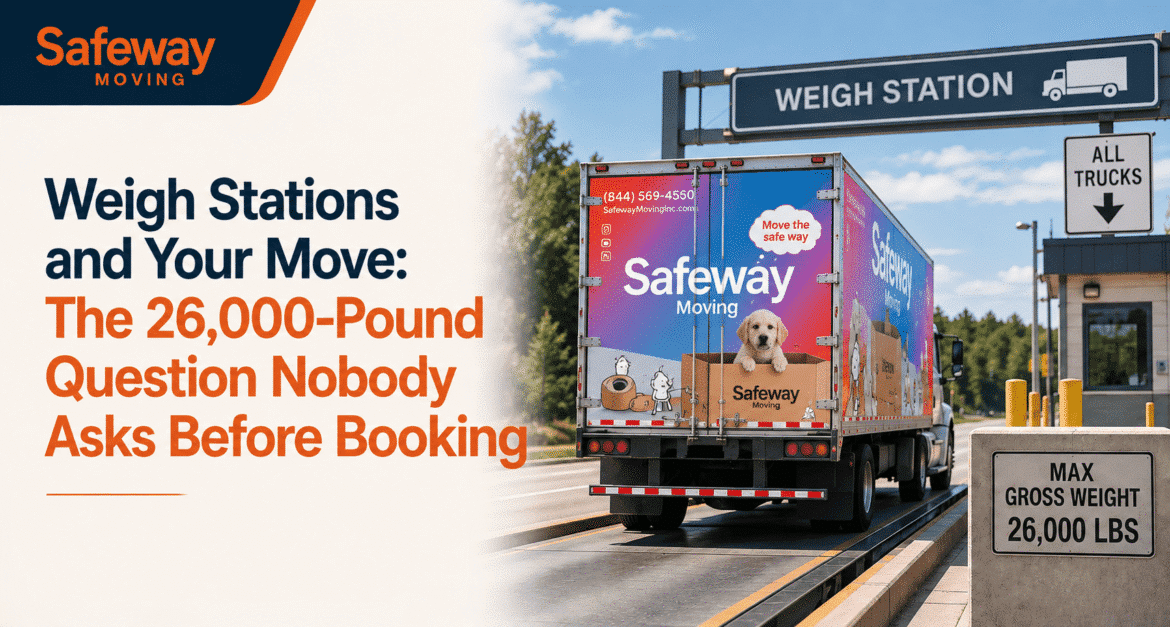
Yes, real moving trucks stop at weigh stations. Roughly 750 permanent scale houses- truckers call them chicken coops- police America’s interstates, and a loaded 26-foot box truck is legally required to pull into open scales in at least 32 of 50 states. Here’s why that matters when you’re hiring a mover: a typical 3-bedroom household weighs 9,000 to 12,000 pounds, and a 26-foot box truck can legally carry about 10,000. A company promising to drive your 3-bedroom home 500-plus miles in a single box truck is describing a trip where the truck is either overweight, dodging scales, or both. This guide shows you the stations, the state rules, the weight math, and a 5-minute route check to run before you sign anything.
750 checkpoints between you and your new home
A weigh station is a state-run enforcement stop, usually just off the interstate, where commercial vehicles are weighed on fixed platform scales or weigh-in-motion sensors that read trucks at speed, and screened for safety: brakes, tires, lights, cargo securement, driver credentials, hours of service. The scale house never lies, which is precisely why it exists: an overweight truck stops longer, brakes worse, blows tires more often, and grinds roadbeds and bridges out of spec. Federal law caps any vehicle on the interstate at 80,000 pounds gross; states set their own thresholds for who must pull in.
Enforcement is not evenly spread. The heaviest concentrations sit on the exact corridors Americans move along: I-95 down the East Coast (Virginia, the Carolinas, Georgia and Florida run some of the most active scales in the country), I-10 across the South (the Ehrenberg, AZ and Banning, CA stations are among the busiest anywhere), I-80 across the plains and mountains, and I-5 on the West Coast, where California operates 24-hour facilities. Two more wrinkles most consumers never hear about: states also deploy portable scales, wheel-weigher pads that can turn any rest area or shoulder into a weigh station with zero notice, and the Commercial Vehicle Safety Alliance runs national inspection blitzes every year, typically in May and September. September, in other words: moving season overlaps inspection season. In Safeway’s own pricing file, June alone accounts for 27% of first-half demand; peak moving weeks are exactly when scale traffic and enforcement staffing peak too.
Who legally has to stop: all 50 states
Stop requirements key off a truck’s Gross Vehicle Weight Rating (GVWR), the manufacturer’s maximum rated weight, printed on the driver’s door sill, not how much happens to be inside. An empty truck with a big enough rating still has to pull in. Seven states weigh every truck; most others set a GVWR threshold, and 10,000 pounds is the most common line. For professional movers hauling for pay, the rules are even stricter: a commercial motor vehicle over 10,000 pounds GVWR is federally regulated interstate, no matter the state.
| Rule | States |
|---|---|
| ALL trucks must stop, no threshold (7) | California, Florida, Kansas, Nebraska, Pennsylvania, South Carolina, Vermont |
| Stop if GVWR over ~8,000-10,000 lbs (22) | Alaska, Arizona, Delaware, Georgia, Hawaii, Idaho, Indiana, Iowa, Maine, Maryland, Minnesota, New Jersey, New York, North Carolina, North Dakota, Ohio, South Dakota (8k), Utah, Virginia, Washington, Wisconsin, Wyoming |
| Stop at a higher threshold (6) | Illinois (16,000), Missouri (18,000), Oregon (20,000), Colorado, Connecticut, Montana (26,000) |
| No stop generally required for movers* (15) | Alabama, Arkansas, Kentucky, Louisiana, Massachusetts, Michigan, Mississippi, Nevada, New Hampshire, New Mexico, Oklahoma, Rhode Island, Tennessee, Texas, West Virginia |
In every state, posted signs and officers override the default, “all trucks proceed to scales” means exactly that, and skipping a required stop is a citable offense everywhere, a misdemeanor in states like California and Virginia. Rules change; confirm with each state DOT.
The box truck weight problem, in real numbers
Now the math that the “we’ll just drive it straight there in the box truck” pitch skips. A box truck, the straight truck you see in every rental lot and behind most small moving outfits, tops out at a GVWR of 26,000 pounds, deliberately one pound under the threshold that would require a CDL. That 26,000 is not carrying capacity. Subtract the truck itself:
| Truck | GVWR | Empty weight | Legal payload |
|---|---|---|---|
| U-Haul 26' | 25,999 lbs | 12,859 lbs | 13,140 lbs |
| Penske 26' | 26,000 lbs | 16,000 lbs | 10,000 lbs |
| Budget 26' | 26,000 lbs | 16,000 lbs | 9,180 lbs |
| Penske 16' | 12,500 lbs | 8,200 lbs | 4,300 lbs |
| U-Haul 15' | 14,500 lbs | 8,115 lbs | 6,385 lbs |
Read those two tables together and the problem is visible from across the street. A professional crew also carries 800-1,200 pounds of its own equipment, furniture pads, dollies, tools, straps, packing materials. On a Penske-class 26-footer that leaves roughly 8,800 usable pounds. A 3-bedroom move sits at 9,000-12,000. The truck is overweight before the garage is loaded. A 4-bedroom home can exceed the limit by two and a half tons. Compare the vehicle long-haul carriers actually use: a tractor-trailer’s 80,000-pound federal ceiling leaves 40,000-plus pounds of cargo capacity, your entire 4-bedroom household, the crew’s equipment, and legal headroom to spare, which is why it can also carry two or three households’ worth of properly partitioned shipments without flirting with a violation.
“Direct delivery, 500 miles, one box truck,” measured in scale crossings
The pitch sounds wonderful: no transfers, your stuff on one small truck, driven straight through. Past about 500 miles, run the route math before believing it. Every corridor below is one Safeway prices every week, the same lanes ranked by volume in the 2026 migration report; here is how many states a 26-foot box truck must legally stop in along the way:
| Corridor (typical routing) | States crossed | Must-stop states for a loaded 26' box truck |
|---|---|---|
| New York → Florida (I-95) | 9 | 9, every state on the route, NY included (SC and FL stop ALL trucks) |
| San Francisco → New York (I-80) | 11 | 10, CA, UT, WY, NE, IA, IL, IN, OH, PA, NJ |
| California → Texas (I-10) | 4 | 2, CA (all trucks), AZ |
| California → Florida (I-10) | 8 | 3, CA, AZ, FL |
| New York → Los Angeles (I-80/I-40) | 10–12 | 7–9 depending on routing |
An overweight box truck on one of these runs has exactly three options at an open scale, and none of them ends with your furniture arriving on schedule. Option one: cross the scale and take the citation; overweight fines scale with the excess; the violation lands on the carrier’s federal record; and, in serious cases, the officer orders the load off the truck right there. Option two: dodge the station, a misdemeanor in several states, and officers do radio ahead. Option three, the one that actually happens to consumers: the truck gets parked, “out of service,” with your household locked inside it in a state you don’t live in, on no particular timeline. And even a legal, under-weight box truck pulling into eight scale stops adds hours a quoted “direct” timeline rarely admits. Portable scales close the back roads loophole. This is also where lowball pricing connects: an operator quoting a 3-bedroom coast-to-coast at a price that only works with one box truck and one driver has priced a trip the scales won’t let happen legally, the same bait-and-switch mechanics covered in how re-quote scams actually work.
Out of service: the number that predicts whether your stuff arrives
Every scale stop can become a full inspection, and inspections end one of two ways: the truck rolls on, or it’s placed out of service (OOS), parked where it stands until the violation is fixed. Nationally, that second outcome is not rare. FMCSA’s running national average puts the vehicle out-of-service rate around one in five inspections, and CVSA’s 2025 International Roadcheck blitz sidelined 18.1% of the 56,000-plus vehicles it inspected.
This is one of the most revealing, and least marketed, statistics about any moving company, and it’s public. Safeway’s record, straight from FMCSA’s SAFER system, runs well below the national vehicle and driver out-of-service averages. Behind that record is a fleet built for the job: straight trucks where they belong, on local work and shuttle legs, and tractor-trailers with legal weight headroom on the long hauls, covering roughly 3.6 million miles in 2024. Every long-distance shipment is barcode-scanned at pickup and tracked by GPS, so a scale stop is a pause, not a mystery, the same visibility covered in what actually happens to your furniture on a long-haul move. Verify every number in this section yourself at safer.fmcsa.dot.gov under USDOT 3756000, MC 1335229.
The 5-minute route check to run before you book anyone
Here is the practice Safeway recommends to every consumer, whoever you end up hiring. First, check your own route: see every state you’ll cross, which ones require a loaded moving truck to stop, and what the rules are at each line. Second, ask the company two questions: “What equipment runs my move past the first 500 miles?” (a specific answer names a tractor-trailer or explains the shuttle plan; a vague one means a box truck) and “Is my quote binding?” Third, put their USDOT number into safer.fmcsa.dot.gov and read their out-of-service rates against the national averages printed on the same page. Two minutes per company, and it filters harder than any review site.
Frequently Asked Questions
Get a mover the scales can’t surprise
Safeway Moving runs interstate moves the compliant way: the right truck for the load, flat-rate binding quotes after a triple-check virtual survey, barcoded inventory with live GPS, 30 days of free storage on interstate moves, and a public federal safety record well below the national out-of-service average. Every route in Safeway’s interstate moving network runs on this same standard. Veteran-owned; a carrier, not a broker.