





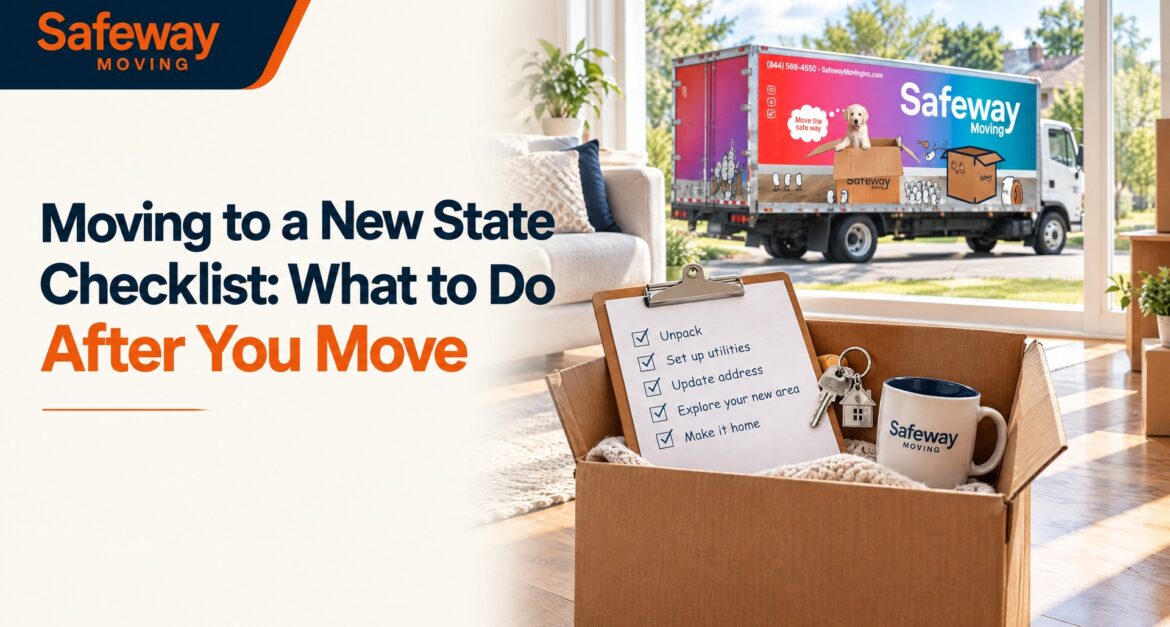
The first thing to do after moving to a new state is check your delivery against your inventory before the movers leave. The second is to look up your new state’s DMV rules, because each state sets its own deadlines for your license and car registration.
This checklist covers the three stretches that matter: delivery day, the first week and the first 30 days. It starts with what to do before the truck leaves, because a good delivery day depends on it.
Before the truck leaves your old home
- Get everything in writing. Your quote, the pickup and delivery windows, the crew size and what the price covers. A flat-rate binding quote after a video walkthrough means your price holds if your inventory doesn’t change. Here’s the difference between binding and non-binding estimates.
- Know who is moving you. A carrier owns the trucks and crews and a broker hands the job to someone else. See moving broker vs carrier.
- Keep essentials with you: medications, documents, chargers, jewelry and a few days of clothes.
- Photograph valuables and keep a copy of the inventory the movers prepare at pickup.
The first 24 hours
- Be at the new address, or send someone. Someone who can approve the inventory and direct rooms should be there.
- Clear a path. Move cars, open doors and protect floors before the movers arrive.
- Check each item off the inventory as it comes off the truck. Our barcode system scans every item at pickup and again at delivery, which makes this check faster.
- Note damage on the paperwork before the crew leaves, and take photos. If something is hurt, here is what a damage claim looks like.
- Open the first-night box. Bedding, toiletries, chargers and basic kitchen items should be the first things you reach.
If the truck couldn’t get close to your door, a smaller shuttle truck may have carried your things the last stretch. Our shuttle checker shows whether an address needs one, and when a moving truck needs a shuttle explains why.
The first week
- Unpack in priority order: beds, bathrooms, kitchen basics, then everything else.
- Turn on utilities and internet, or confirm they were switched on before you arrived.
- Forward your mail with the post office and update your address with your bank, your employer and your insurers.
- Find the basics: a doctor, a pharmacy and the nearest grocery store, and send your medical and school records to the new providers.
- Look up your new state’s DMV rules. Deadlines for a driver’s license and car registration differ from state to state, so check the DMV website for yours.
The first 30 days
- Update your license and registration within your new state’s deadline.
- Update your voter registration and your car and home insurance for the new address.
- Finish unpacking and look over larger pieces for damage you missed on delivery day. Report anything you find as soon as you do.
- If your things are in storage, plan the delivery. Interstate moves with us include 30 days of free storage, and storage in transit explains how it works.
Mistakes to avoid after a long-distance move
- Signing off before you’ve checked. Once the crew leaves, a missing or damaged item is harder to document. Check the inventory first.
- Waiting on the DMV. A missed deadline can mean fines or a lapse in registration, so put the date in your calendar in week one.
- Leaving boxes sealed for months. Open and inspect them early, and ask your mover how long you have to report damage and how to file.
- Forgetting recurring accounts. Subscriptions, deliveries and insurance policies still point to your old address until you change them.
- Skipping the walkthrough of your new home. Note any existing damage on the day you arrive, before boxes cover it.
If you’re moving with kids or pets
A cross-country move is hard on children and animals as well as on belongings. Set up their space first, with a familiar bed, favorite toys and the things they use every day, so there’s one calm room in a house full of boxes. Keep your pet’s records and medications with you, and find a local vet in your first week. For more on traveling with animals, read moving with pets from Florida to the West Coast. With kids, let them choose which box to open first and keep their school and medical records handy for the new providers.
Budgeting for the move itself
The moving bill is one part of the cost of a new state, but it’s the part you can plan. Nationally, a typical interstate move we priced cost $4,175 for a studio or 1-bedroom, $4,981 for 2 bedrooms, $7,520 for 3 bedrooms and $12,500 for 4 or more bedrooms.
| Home size | Typical price (national) | Usual range |
|---|---|---|
| Studio / 1 bedroom | $4,175 | $3,650 – $4,950 |
| 2 bedrooms | $4,981 | $4,415 – $5,797 |
| 3 bedrooms | $7,520 | $6,605 – $8,930 |
| 4+ bedrooms | $12,500 | $10,395 – $15,735 |
Source: based on interstate moves we priced from January to mid-July 2026. These are national figures for all interstate routes, not a price for this route alone. A typical price means half of the moves we priced came in lower and half came in higher.
Summer moves cost about 19.5% more than off-season moves in our booked data, and a truck just for you, with a delivery date you choose, typically adds $1,500–$4,500. For ways to lower the total, read the cheapest way to move across the country and how much movers cost in 2026.
Planning your next move, or your first
Browse our interstate moving routes to see typical distances and timing for your corridor, or start with how to move cross country if you’re still planning.
Get a flat-rate price for your move
We also cover moving from New York to Florida and moving from California to Florida. Use our moving cost calculator for a first number, then call us at (844) 569-4550 for a binding flat-rate quote after a video walkthrough. Before you hire anyone, check who is actually doing the move: we hold our own federal authority (USDOT 3756000, MC 1335229), and this guide shows how to read a DOT record.
Frequently Asked Questions
Check your delivery against your inventory before the movers leave, and note any damage on the paperwork. Then keep your essentials within reach and look up your new state’s DMV rules.
Each state sets its own deadline, so check your new state’s DMV website. Do it in your first weeks so you don’t miss it.
Note it on the paperwork before the crew leaves, take photos and report it as soon as you find it. Checking each item off the inventory as it comes off the truck makes a missing item easy to spot.
Start the mail forward and update your bank, employer and insurers in the first week, once you know your new address and move-in date are firm.
Methodology: National prices come from interstate moves Safeway priced from January to mid-July 2026 (quote data). Timing figures come from moves customers booked with Safeway Moving, 2020–2026 (booked data); the booking ranges are company guidance, not statistics. Nothing here is a price for one specific route; your exact price is a flat, binding rate after a video walkthrough. We publish shares and typical figures only; we don’t publish counts.