





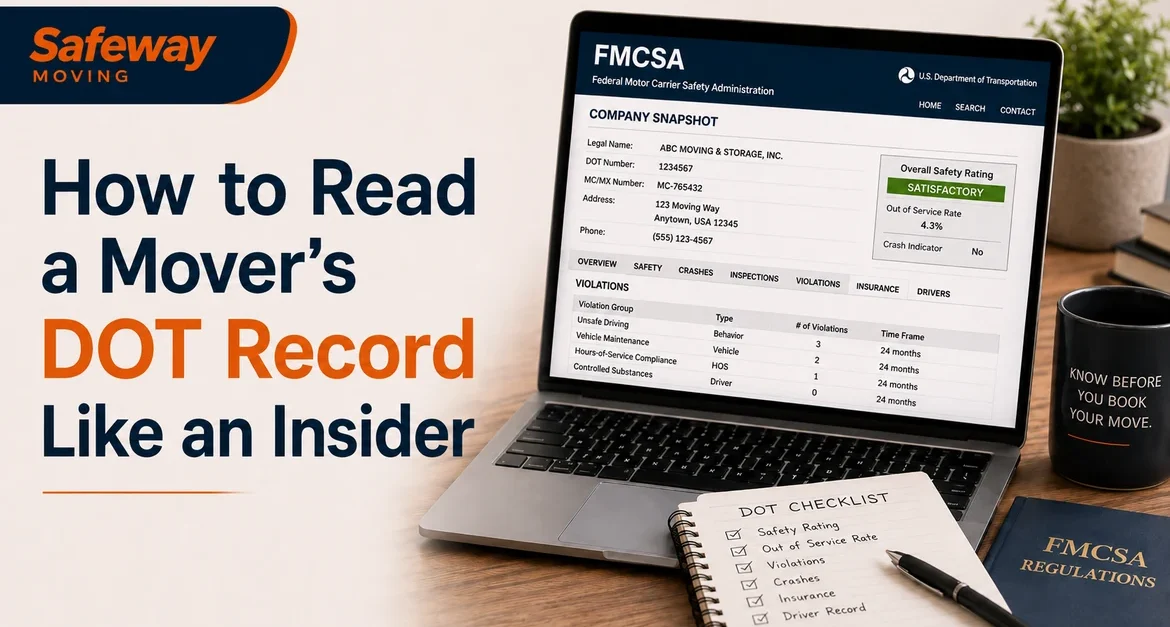
Everyone says “check the DOT number.” Almost nobody knows what to actually look at. Here’s how to pull a mover’s federal record and read the five things that reveal whether they’re real, including whether they even own the trucks they claim.
By Boris, Owner, Safeway Moving
“Verify the DOT number” is the advice every article gives, and almost no one explains. So people glance at a company’s page, see a green “Active” badge and a truck count, feel reassured, and book. That surface check is exactly what a scammer is counting on, because the number that matters isn’t whether a record exists, it’s what’s inside it.
I’ve operated inside this federal system for years. Let me walk you through how to pull a mover’s actual record and read it the way people in the industry do, past the complaint count and the truck total a company claims, down to whether they’re legally authorized to move your household goods across state lines, whether they carry the right insurance, and whether they even own trucks at all.
Where to look (and where not to)
Pull the record yourself at the source: safer.fmcsa.dot.gov (the SAFER Company Snapshot), free, searchable by USDOT number, MC number, or company name, no login. For deeper detail on authority and insurance, the FMCSA Licensing & Insurance (L&I) system shows the same entity’s authority types, cargo authorizations, and insurance filings.
Two ground rules before you start. First, never accept a screenshot a salesperson sends you, anyone can alter what a webpage displays before capturing it. Pull it yourself. Second, treat this as a first screen, not gospel: the record tells you a great deal, but it’s a starting point for your judgment, not a full audit.
Now, the five things to actually read.
1. Entity type: carrier or broker?
The record lists what the company legally is: a Carrier, a Broker, a Freight Forwarder, or some combination. This is the first fork in the road. A carrier owns trucks and moves your goods. A broker sells your job to a carrier you’ve never met. A company can hold more than one authority, so read carefully: an operation that is only a broker is telling you, in federal ink, that someone else entirely will show up with the truck.
2. Operating authority: is it actually “Authorized,” and for what?
Authority is the legal permission to operate for hire across state lines, and it comes in types (Common and Contract authority for carriers, Broker authority for brokers). What you want to see is a status of Authorized / Active. Watch for:
- Inactive: the authority has been revoked, and for-hire interstate operation is illegal. Hard stop.
- None: never registered for that authority type (an application may be pending, denied, or withdrawn).
- Revocation pending: a red flag in progress.
If a company wants to haul your belongings from one state to another, active interstate authority isn’t optional; its absence is a deal-breaker, full stop.
3. Household goods authorization: are they even allowed to move homes?
This is the step almost no consumer takes, and it’s decisive. The L&I record shows the categories of cargo a carrier is authorized to transport, and Household Goods is its own specific category. Moving household goods for the public carries extra consumer-protection obligations, so a legitimate mover will be authorized specifically for it. A company with general freight authority but no household-goods authorization, quoting your home move, is operating outside its lane, sometimes literally.
4. Insurance on file: the quiet tell that separates real movers from paper ones
Insurance filings are where a lot of masks slip. For an interstate household-goods carrier, you want to see:
- BIPD (bodily injury and property damage liability) on file and active, the baseline for any for-hire carrier.
- Cargo insurance: federally required specifically for household-goods carriers. Its presence is a strong signal you’re dealing with an actual HHG mover; its absence on a company quoting your home move is a serious question mark.
A pure broker, by contrast, isn’t required to carry cargo insurance on trucks it doesn’t own; instead, it must maintain a surety bond or trust fund. So the insurance section quietly confirms what type of company you’re really dealing with: real carriers show BIPD and cargo coverage; brokers show a bond. If the “mover” you’re about to hand your life’s belongings to has only a broker’s bond and no cargo insurance, you’ve learned something the sales pitch would never tell you.
5. Power units and inspections: do they own the trucks, and do they run them?
Finally, the fleet. The record shows power units (trucks, tractors, and straight trucks) and drivers, but understand where that number comes from: it’s self-reported by the company on its MCS-150 filing, updated on its schedule, and, by the system’s own admission, may not reflect the current fleet. So use it as a sanity check, not scripture:
- Does the fleet match the story? A company claiming to run 50 trucks nationwide but showing 3 power units has explaining to do.
- Tractors vs. straight trucks. Long-distance interstate moves generally require tractors pulling trailers. A company that shows only a couple of straight trucks but sells cross-country moves may be a local operation quietly subcontracting the long haul to someone else.
- How stale is the filing? An MCS-150 last updated more than two years ago means the whole snapshot may be out of date.
- Crash and inspection history. The record carries 24 months of inspection and crash data. Here’s a subtle one: a company that holds authority but has almost no inspections over two years may not actually be running trucks interstate at all, which is exactly what you’d expect from a broker wearing a carrier’s costume.
Put it together
Ninety seconds of real reading beats a green badge every time. Before you book, confirm: they’re a carrier (not only a broker), with active interstate authority, specifically authorized for household goods, carrying BIPD and cargo insurance, with a fleet and inspection history that actually match the move they’re selling you.
Any single “run” signal on its own, revoked authority, no cargo insurance, broker-only, a fleet that doesn’t add up, a two-year-stale filing, is enough to walk. Stack two of them, and you’ve just dodged a scam that a complaint count alone would never have shown you.
Boris is the owner of Safeway Moving, a national carrier, authority, household-goods authorization, and insurance all verifiable at the source. Get a transparent quote from an out-of-state moving company you can verify.