





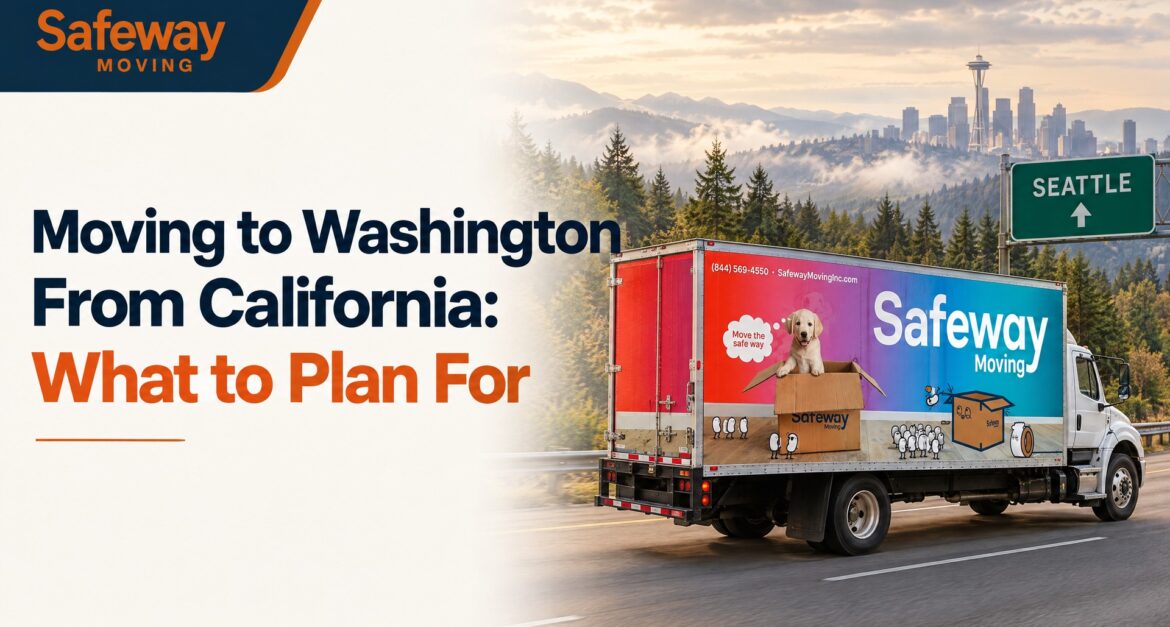
California to Washington is roughly 750 to 1,250 miles, mostly along I-5. Book 30 to 45 days ahead, expect a delivery window, and get a flat-rate binding quote before you commit to a date.
The trip north
Distance depends on where you start and finish. From the Bay Area to the Seattle area you’re near the shorter end of that range; from Southern California you’re closer to the longer end. Our Washington to California moving page covers the same corridor in the other direction.
How many Californians are leaving
California has more departures than any other state in our data. California to Texas is our busiest route, with about 1 in 6 departing California households Texas-bound, and about one household headed to Florida for every two headed to Texas.
Source: based on interstate moves we priced from January to mid-July 2026.
What it costs
Nationally, a typical interstate move we priced cost $4,175 for a studio or 1-bedroom, $4,981 for 2 bedrooms, $7,520 for 3 bedrooms and $12,500 for 4 or more bedrooms. Your own price depends on mileage, inventory, access and date.
| Home size | Typical price (national) | Usual range |
|---|---|---|
| Studio / 1 bedroom | $4,175 | $3,650 – $4,950 |
| 2 bedrooms | $4,981 | $4,415 – $5,797 |
| 3 bedrooms | $7,520 | $6,605 – $8,930 |
| 4+ bedrooms | $12,500 | $10,395 – $15,735 |
Source: based on interstate moves we priced from January to mid-July 2026. These are national figures for all interstate routes, not a price for this route alone. A typical price means half of the moves we priced came in lower and half came in higher.
Timing your move
In moves customers booked with us, June is the busiest month at about 14% of the year’s moves, February the quietest at about 5%, about 29% of moves land in the last week of the month, and summer moves cost about 19.5% more than off-season moves. The typical customer books 34 days ahead. Our guidance is 30 to 45 days if you’re selling a home, 3 to 4 weeks if you rent, and more notice for June or month-end dates. The 8th through the 20th is usually easiest.
Source: timing figures are based on moves customers booked with us, 2020–2026. The booking ranges are company guidance, not statistics.
Plan for your Washington address
Seattle-area addresses often mean hills, narrow streets and older buildings with tight stairwells or small elevators. Show every approach to the door on your video walkthrough so the crew and truck are planned correctly. A long-distance truck is an 18-wheeler; check your address with our shuttle checker.
If you can’t take possession of your new place right away, storage in transit lets your things wait until you’re ready.
Coming from the East Coast instead? See our New York to Seattle and New Jersey to Seattle pages.
Where in California you start changes the trip
The corridor is about 750 to 1,250 miles, but where you fall in that range comes down to your starting city. A Bay Area departure is at the shorter end, while a Southern California departure is at the longer end. Distance moves the price, so it’s worth getting your quote with exact addresses instead of a region.
Seattle-area homes and access
- Hills and narrow streets. A steep or tight street can keep a long-distance truck from parking at the door. Show the street on your video walkthrough.
- Apartments and condos. Ask for the elevator reservation process, move-in hours and any loading-dock rules before you book your date.
- Older buildings. Narrow stairwells and small elevators can slow loading and limit large furniture, so measure big pieces.
If you’re selling or renting
Dates drive almost everything. If you’re selling in California, your closing date sets your pickup date, so read your closing date is a price. If you rent, ask your landlord whether the lease can end mid-month, which gives you more choice of dates. If the dates still don’t line up, storage in transit lets your things wait until your Washington place is ready.
A short timeline
- 6 to 8 weeks before: start quotes and set a date range.
- 3 to 4 weeks before: declutter, then do the video walkthrough so the quote reflects the lighter load.
- The last 2 weeks: confirm pickup and delivery windows, building rules and utilities at both ends.
- Delivery day: check each item off the inventory before the crew leaves.
Packing tips for this move
The trip up I-5 is long enough that how you pack matters. A few habits make the whole trip easier:
- Heavy items in small boxes. Books and tools go in small boxes; linens and clothes go in large ones. A box you can lift is a box that stays intact.
- Label by room, and by priority. Mark the room and what’s inside, and put a visible mark on anything you’ll want first.
- Don’t overfill. Bulging boxes crush and shift. Fill gaps with paper or towels.
- Wrap furniture corners and keep fragile items in labeled boxes you can find first.
- Know what can’t ride. Movers generally can’t carry flammables, propane, aerosols or similar hazardous items, so ask for the list before packing day.
Short on time? Our packing services can pack for you and are priced separately from the move.
More guides for this route
Before you book a move up the coast, these guides are worth a look.
- How much movers cost in 2026: what drives a long-distance price and how to read a quote
- Binding vs non-binding estimates: why the type of quote decides what you pay at delivery
- Moving broker vs carrier: how to tell who is actually moving you
- When a moving truck needs a shuttle: what happens when the 18-wheeler can’t reach your door
The fastest way to turn this guidance into a real number is a video walkthrough, which gives you a binding flat-rate price for your own inventory, addresses and dates.
Get a flat-rate price for your move
We also cover movers in California and movers in Washington. Use our moving cost calculator for a first number, then call us at (844) 569-4550 for a binding flat-rate quote after a video walkthrough. Before you hire anyone, check who is actually doing the move: we hold our own federal authority (USDOT 3756000, MC 1335229), and this guide shows how to read a DOT record.
Frequently Asked Questions
Roughly 750 to 1,250 miles, depending on where in California you start and where in Washington you finish.
Nationally, a typical interstate move we priced from January to mid-July 2026 cost $4,175 for a studio or 1-bedroom, $4,981 for 2 bedrooms, $7,520 for 3 bedrooms and $12,500 for 4 or more bedrooms. These are national figures, not a price for this route alone.
We suggest 30 to 45 days ahead if you’re selling a home and 3 to 4 weeks if you rent, with more notice for June or month-end dates. The typical customer books 34 days ahead.
Most long-distance moves share a truck, so delivery comes in a window. A truck just for you with a delivery date you choose typically adds $1,500–$4,500, depending on distance and destination.
Methodology: National prices come from interstate moves Safeway priced from January to mid-July 2026 (quote data). Timing figures come from moves customers booked with Safeway Moving, 2020–2026 (booked data); the booking ranges are company guidance, not statistics. Nothing here is a price for one specific route; your exact price is a flat, binding rate after a video walkthrough. We publish shares and typical figures only; we don’t publish counts.