





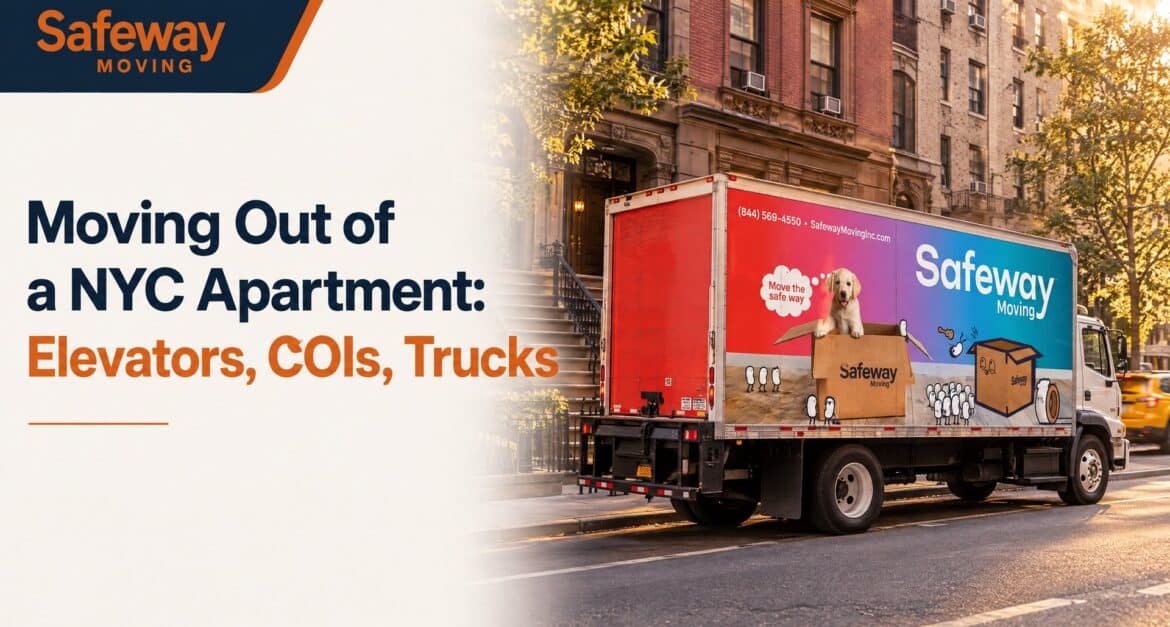
Moving out of a New York City apartment starts with the building, not the truck. Reserve the freight elevator, ask whether your building wants a certificate of insurance, and check that a long-distance truck can reach your block. Do those three things first and your move date will hold.
Start with the building
Most apartment moves in the city run through a managing agent or a building manager. Ask for the move-out rules in writing, then work through this list:
- Freight elevator: many buildings want it reserved for a set window, and slots fill up fast around month-end.
- Certificate of insurance: many co-ops, condos and managed rentals want proof of insurance on file before they approve a move. Request one through our COI request page.
- House rules: in a co-op, the managing agent can tell you whether the move needs a separate notice to the board.
- Stairs and long carries: walk-ups and long hallways take longer, so show them on your video walkthrough.
Book the elevator as soon as you have a date. Tell us the window so your pickup lines up with it, and request the insurance certificate early, since some buildings want it before they will confirm a slot.
Can a long-distance truck reach your block?
NYC DOT tells truck drivers to follow every posted restriction and to watch for designated truck routes, and the city’s traffic rules sit in Chapter 4 of Title 34 of the Rules of the City of New York. Call 311 about your block before move day, and show us the street and the building entrance on your video walkthrough.
Long-distance trucks are 18-wheelers about 70 feet long and more than 13 feet tall, so a smaller shuttle truck is sometimes needed to reach a narrow street or tight complex. Check your address with our shuttle checker and read when a moving truck needs a shuttle.
On a narrow block, a smaller shuttle truck carries your belongings the last stretch to the big truck. We plan for it before move day so it never comes as a surprise.
Walk-ups, co-ops and towers move differently
New York apartments are not one kind of building. These are the neighborhoods we have written up, and what changes the move in each:
- Upper East Side: many buildings are prewar co-ops with elevators, so house rules set the schedule. See Upper East Side movers.
- Williamsburg: waterfront towers book loading areas and elevators, while older blocks mean stairs. See Williamsburg movers.
- Harlem: brownstones and converted walk-ups mean stoops and several flights. See Harlem movers.
- Astoria: prewar walk-ups, townhouse-style homes and newer waterfront buildings each need their own plan. See Astoria movers.
We also cover Brooklyn, Queens, the Bronx and New York County.
What a move out of New York costs
Nationally, a typical interstate move we priced cost $4,175 for a studio or 1-bedroom, $4,981 for 2 bedrooms, $7,520 for 3 bedrooms and $12,500 for 4 or more bedrooms. Your own price depends on mileage, inventory, access at both ends and your date.
| Home size | Typical price (national) | Usual range |
|---|---|---|
| Studio / 1 bedroom | $4,175 | $3,650 – $4,950 |
| 2 bedrooms | $4,981 | $4,415 – $5,797 |
| 3 bedrooms | $7,520 | $6,605 – $8,930 |
| 4+ bedrooms | $12,500 | $10,395 – $15,735 |
Source: based on interstate moves we priced from January to mid-July 2026. These are national figures for all interstate routes, not a price for this route alone. A typical price means half of the moves we priced came in lower and half came in higher.
What moves your number on a long-distance trip out of the city:
- Season: summer moves cost about 19.5% more than off-season moves in our booked data.
- Delivery: a truck just for you, with a delivery date you choose, typically adds $1,500–$4,500, depending on distance and destination.
- Access: stairs, long carries and tight streets add time. Check your address with our shuttle checker.
- Inventory: what goes on the truck sets the price, so move only what you need.
Source: based on moves customers booked with us, 2020–2026.
For a fuller national picture, read how much movers cost in 2026 and run your inventory through the moving cost calculator.
When to book
In moves customers booked with us, June is the busiest month at about 14% of the year’s moves, February the quietest at about 5%, about 29% of moves land in the last week of the month, and summer moves cost about 19.5% more than off-season moves. The typical customer books 34 days ahead. Our guidance is 30 to 45 days if you’re selling a home, 3 to 4 weeks if you rent, and more notice for June or month-end dates. The 8th through the 20th is usually easiest.
Source: timing figures are based on moves customers booked with us, 2020–2026. The booking ranges are company guidance, not statistics.
New York customers book about 40 days ahead, which is longer than the typical customer. Long-distance delivery arrives in a window, so leave some slack between your move-out day and your move-in day. If your dates cannot line up, storage in transit holds your things, and interstate moves include 30 days of free storage.
Packing for the elevator
- Heavy items in small boxes. Books and tools go in small boxes, linens and clothes in large ones.
- Label by room and priority, and keep a first-night box with chargers, toiletries, bedding and basic kitchen items.
- Photograph valuables before they are packed, and carry medications, documents and jewelry yourself.
- Protect the building. Elevator pads and floor protection are easier to arrange when the movers know about them in advance.
Short on time? Our packing services can pack for you.
Get a flat-rate price for your move
We move households out of New York to other states, including New York to Florida and New York to Los Angeles. Use our moving cost calculator for a first number, then call us at (844) 569-4550 for a binding flat-rate quote after a video walkthrough. Before you hire anyone, check who is actually doing the move: we hold our own federal authority (USDOT 3756000, MC 1335229), and this guide shows how to read a DOT record.
Frequently Asked Questions
Often, yes. Many buildings want the elevator booked for a set window, so ask your building manager as soon as you have a date.
Many co-ops, condos and managed rentals do. Ask your managing agent what they require, then request a COI through our COI request page.
Check with 311 for your block. NYC DOT tells truck drivers to follow every posted restriction, so show us your street on the video walkthrough.
Not always. Our trucks are about 70 feet long and more than 13 feet tall, so we plan a smaller shuttle truck when a block cannot take one.
Methodology: National prices come from interstate moves Safeway priced from January to mid-July 2026 (quote data). Timing figures come from moves customers booked with Safeway Moving, 2020–2026 (booked data); the booking ranges are company guidance, not statistics. Building and street rules vary by building and block, so confirm them with your building and with 311. Nothing here is a price for one specific route; your exact price is a flat, binding rate after a video walkthrough. We publish shares and typical figures only; we don’t publish counts.